Jesus: A Crushing Rock or a Saving Stone? - Part A
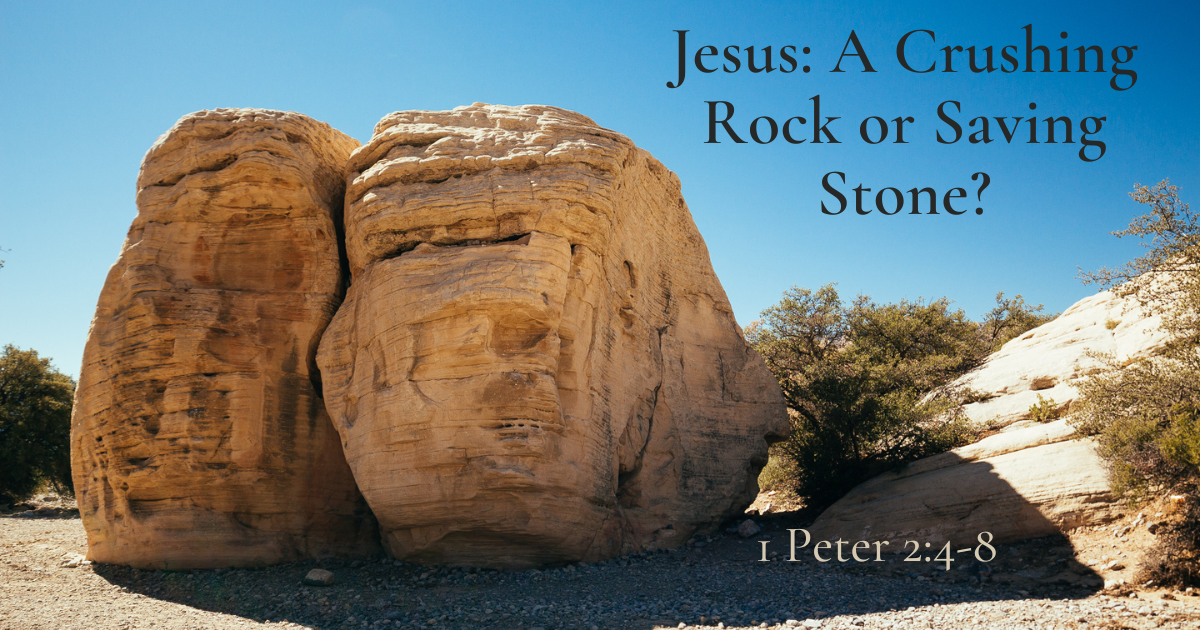
Scripture Reference: 1 Peter 2:4-8
Visit the series page: Exiles: A study in 1 Peter
-
Sermon Series: Spiritual Exiles
Message: Jesus: A Crushing Rock or Saving Stone?
Airdate: 9/24–9/25/26
Programs: 2364 and 2365
Alright, we're coming to our our teaching time now in in First Peter. We're continuing our series in First Peter, and we have a passage in front of us today that is both wonderful and challenging. It is wonderful because of the truth that's in it; it's challenging because the Peter who writes this uses these metaphors and these illustrations, and he kind of mixes them all up, and it's a little hard to get. I actually was looking at this thinking, how am I gonna teach this passage? But my job is to try to make it understandable and simple, and we'll try to do that today. But there's a wonderful truth, there's wonderful truths in here, and I hope God blesses our time in His Word. Are you with me?
Alright, let's talk about stones today. Okay, let's talk about rocks. Rocks and stones. And one of the reasons that Peter talks about stones and rocks, and why we find it throughout Scripture, is because in the first century, in the ancient world, they didn't have things like we have for construction. They didn't have asphalt and steel and iron and things like that that make up the architecture of our cities and our towns. They just basically had wood and rocks.
So when they were going to go to build something, whether it be a road or a building, they would have to have rocks. So everywhere you went, you saw stones and rocks. You walked on rocks, you lived in rocks, rocks and stones all the time. So when it came to illustrating things in in the first century, a very effective one was to talk about rocks and stones, because everybody could relate to that. And Peter here is going to describe Jesus as three different rocks, or three different stones, and I'm gonna read our text today and see if you can pick up on the three stones that Peter describes Jesus as.
I'm reading now, First Peter chapter two, beginning in verse four: “As you come to Him, a living stone rejected by men but in the sight of God chosen and precious, you yourselves like living stones are being built up as a spiritual house, to be a holy priesthood, to offer spiritual sacrifices acceptable to God through Jesus Christ. For it stands in Scripture: behold, I am laying in Zion a stone, a a cornerstone, chosen and precious, and whoever believes in Him will not be put to shame. So the honor is for you who believe; but for those who do not believe, the stone that the builders rejected has become the cornerstone and a stone of stumbling and a rock of offense. They stumble because they disobey the word, as they were destined to do.”
Alright, did you pick up on the three? Can we say them in order? If you, if you did pick up on them, what's the first one? Jesus is a living stone. Secondly, Jesus is a cornerstone. And thirdly, Jesus is a stumbling stone. Yes. And that's just going to basically be our outline here, to talk about Jesus in those three respects. So we begin with Jesus as three kinds of stones.
And just to note, it's a little ironic, isn't it, that Peter of all people is calling Jesus a stone, because after all, what did Jesus call Peter? Do you remember, his name was Simon, actually, and somewhere along the way Jesus says to him, he says, you know what, I'm changing your name, from now on your name is no longer Simon, your name is Peter. But what does Peter mean? Peter means rock. So here we have Jesus calling Peter a rock, and Peter calling Jesus a stone. I find that interesting. K. Very interesting.
So Jesus as the living stone, what does that mean? "As you come to Him, a living stone", what might that be referring to? And when we see, for example, something that is an inanimate object now becoming alive, it sure sounds like, what does it sure sound like, resurrection, doesn't it? For something that is inanimate now to be animate, to be alive. Jesus was dead in the grave, now alive. Living stone refers to the resurrection of Jesus. Stones don't live, stones don't do anything, but in the Bible we find them occasionally being attributed some qualities like that.
For example, you remember when Jesus, in His triumphal entry, the Pharisees come to Him, and as He's coming in they say, tell all these people to stop, they're singing your praises, tell them to stop. And what does Jesus say? If they stop, the rocks will cry out, right? So singing rocks, who's ever heard of singing rocks? Maybe the Rolling Stones is as close as we get to that, right? Rocks don't sing and stones don't live, so a living stone is the most remarkable thing.
And here we're now continuing in the text here to see this illustration that Peter is working. He says he is a living stone rejected by men, but in the sight of God chosen and precious. And if you look at verse six, Peter is about to refer to Isaiah twenty-eight, which says, “behold, I am laying in Zion a stone, a cornerstone, chosen and precious,” and he applies the chosen and precious to Jesus. Now, how is Jesus chosen? How is Jesus precious? Well, Isaiah is foretelling the coming Messiah, and he uses this picture of a mason who is laying the most important stone in the building, the cornerstone. K. So how would a mason go about laying that cornerstone? Well, he probably would go to the quarry, or go to his inventory, and he would pick out the very best stone that he could find.
Why? Because the cornerstone, the shape and the character of the cornerstone, becomes the shape and character of the entire building. The quality, the nature of that stone, shapes the quality and the nature of the rest of the building. And so you wanna make sure you have the very best stone that you can have. And so a mason would look over everything he had and he'd say, this is the cornerstone. And when he selected that stone, it became the chosen stone. K. The chosen stone. These words here are praising three aspects of Jesus' work: he is the living stone, resurrection; he is the chosen stone, Messiah; and he is the precious stone, speaking to his glorious and infinite worth.
And Peter's goal in this language here is to encourage us in what way? Here's the principle: who Jesus is defines who we are when we are in a faith relationship with him. Let me say it again, who Jesus is defines who we are when we are in a faith relationship to him. Like a cornerstone to a building, the cornerstone defines the character and the nature of the rest of the building. Jesus is, for our faith and our salvation, he is that kind of a cornerstone, and when I am in a faith relationship with him, who he is defines who I am. K.
And here's where the met metaphor is mixed a little bit, but he is the living stone because he is alive, because he was resurrected, we now live in that eternal life. I'm in a faith relationship with Jesus, as Jesus said, “I am the resurrection and the life; whoever believes in me will never die,” right? Because I live, so shall you, he says elsewhere. Because he is alive, because he was resurrected, when we are in a faith relationship with him, like a building in relationship to its cornerstone, the qualities that Jesus have become our qualities. And you'll notice then he says here that Jesus is the living stone, and we as, are are, like living stones. K. So he is alive, therefore we also are alive. I told you it's a little challenge here. K. But do you get what it's, what it's saying? I can go over that again. I'm looking around, nobody wants to say. K. More on this, we'll, we'll get going here.
Look at verse five: “what are we, we're living stones, and we are being built up as a spiritual house. For it stands in Scripture: behold, I am laying in Zion a stone, a cornerstone, chosen and precious, and whoever believes in him will not be put to shame.” And so here now we move to the second stone, he is the living stone, he is the cornerstone. Okay, cornerstone, and this quotation from Isaiah twenty-eight, Isaiah prophesies about the Messiah who would come, and his life and his ministry would be a kind of chosen and precious cornerstone. So the living stone is also the cornerstone of a great house, and we, like living stones, are the bricks and the mortar of that house.
So the metaphor mixes here a little bit, but I think that we all can get this, especially if you like Lord of the Rings, and I haven't quoted from Lord of the Rings in at least two or three weeks, so it's time to do it again. If you like Lord of the Rings, or The Hobbit that's recently came out, you know that Tolkien, as he's describing Middle-earth, he talks about kingdoms, you have these various kingdoms, and the kingdoms are known as, for example, the house of Rohan. K. Now, the house of Rohan is not literally a house, but it is a kingdom. It describes the the king of the kingdom, the name of the king of the kingdom, and all who are in that kingdom are of the house of Rohan. Okay, or Gondor is another one. Okay, the kingdom of Gondor, if you are in, if you live in, the kingdom of Gondor, you are of the house of Gondor. It doesn't mean that you are a a brick or a stone, but the people of the kingdom are what make up the house of Gondor. And Peter is saying essentially the same thing here, that we are the of the house of Jesus. We are not literally bricks and mortar, we are living stones. Okay, we're people, but we make up the structure of this spiritual house, the house of Jesus Christ, that is made up of all who put their faith and their trust in him. We are in his kingdom, we are, we are his people.
There's a story that goes about a king that was visiting ancient Sparta, the famous Spartan kingdom, and the the the the the Spartan king was boasting to this visiting Monarch about the walls of Sparta, and as the visiting king looked around, he could see no walled city, and he asked, where are the renowned walls of Sparta? And the Spartan king pointed to his army and replied, these are the walls of Sparta, every man a brick. Okay, and you can say right there, who are the walls of the house of Jesus Christ? Who are the, who are the structures and the beams and the and the the and the the materials of this house, this kingdom? It is those who have put their faith in Jesus, and his life now is their life, and his character now is their character, and we are the they, and we are living out this house, this spiritual house, as the people of God.
For what purpose? Notice: to be a holy priesthood, to offer spiritual sacrifices acceptable to God. We are priests, and this is a little bit of, again the metaphor keeps changing, but we are bricks in the house, but it doesn't mean that we just stand there like this and we do absolutely nothing. Rather, we are priests in this house. And the priests, if you look at the Old Testament, the priests in the Old Testament, what did they do? They represented men to God, and so you went to the temple and you went to the priest, and he took that sheep or that bull or that goat and he offered that sacrifice, and he represented you to God. But in the new covenant, no longer are priests needed, no, no more altars like that. We're not having something after the service, hey, take all your sheep and your bulls and your goats and go to the backroom and we'll offer those sacrifices for you, we don't do that anymore.
Why? Because Christ's death was the once-for-all sacrifice. This new covenant is established by the blood of Jesus, not a bull or a goat or anything else. And so now, in this new covenant, we don't need that priest, that man that represents us to God, why? Because we are all priests in this house. We all have direct access to God, which Jesus has provided for us, he says that in the text, right, acceptable, acceptable to God through Jesus Christ. When Christ died, what happened to that veil in the temple? Torn in two, right? Representing the fact that from now on there is not one temple, and there are not priests; rather, there is one high priest, Jesus, and we are all priests, then, praying directly to God. We all have the ability to know and understand and interpret the word of God and apply it to our life. We minister to one another as priests in this house. It is a tremendous privilege to be a priest of God through Jesus Christ, and to offer, notice, spiritual sacrifices acceptable to God.
Did you know, Christian, if you're a Christian, you're offering sacrifices? You're like, I didn't know that. Well, what kind of sacrifices might a Christian offer as a priest? Here are some, the Bible describes, Romans twelve one, we offer our bodies to God for service, my life, my body, the use of my body, my my day to day. I want this to be an act of worship to you, God. What was that song we started with, every praise to our God, every praise to our, here's the team over here, help me out, every praise to our God, every word of worship to our God, every praise, every praise to our God, yeah, they need me and Gary, what that means, but that's basically saying this point, that as a Christian and as a priest now, I have the privilege and the opportunity for everything that I do, every word of worship to our God, all my life now is to be, and can be, lived as a kind of offering directly to God through Jesus Christ, and God delights in it. K.
When God, God delighted in the sacrifices in the Old Testament that were offered up in praise and worship to him, and now my whole life can be lived in a way that brings pleasure to God, as a kind of offering to God. Whether you eat or drink or whatever you do, do it all to the glory of God. And to, what a, what a freeing and joyous principle that is, to connect my whole life, all of it, my vocation and my recreation and my my health and my relationships and my marriage and my parenting and all the things that make up my life, all of it now, not just, not for me, but offered as a kind of glory to God.
So if you're a Christian, you're a priest. The question is, are you a good one? Maybe to think about this week in your life: what did I do conscious of the presence of God, and intentionally done in a way pleasing to him? How did you do this week, Christian? Were you aware of God through the day? Were you aware of God, his watchful eye, the seeking of his pleasure with your words, your tongue, your giving, your love to others, all of it, as priests in this spiritual house of Jesus, pleasing to him? How might your week change if you saw each category of your life as an offering to God?
Jesus is the cornerstone of the church. The third stone that we have here is a surprising one, I think, if you were just reading through First Peter, you wouldn't expect him to take the turn that he does here, but he talks about Jesus as the stumbling stone, and to do so he quotes again Old Testament, two passages that refer to, let me read them, let me read them here, a second, verse seven: “so the honor, the honor of being a priest, the honor of being in the house, is for you who believe; but for those who do not believe, the stone that the builders rejected has become the cornerstone and a stone of stumbling and a rock of offense. They stumble because they disobey the word, as they were destined to do.” These are very sobering words here that Peter shares. He quotes from Isaiah one eighteen and Isaiah, I’m sorry, Psalm one eighteen and Isaiah eight, and both of these are using this stone language, but they're talking about a fearful truth: the fact that we either believe in Jesus unto everlasting life, or we reject him and stumble over him to our eternal destruction.
Stumbling, the stumble stone, again, let's go back to the first century. If everywhere you walk you're walking on a path that's been worn down, or you're walking, maybe, in the city, you're on a a street that has cobblestones or is made up of some kind of stone, I would imagine that stumbling would be a daily occurrence. Okay, but now we're used to, here we have all smooth pathways, and if you know your sidewalk is off a little bit, the city is going to sue you, and you know, we live in a very smooth society, right? Everything we go, everything's smooth, everything's nice, if you stumble, you sue people. There was no suing of people in the first century, your rock is a little high there and I'm suing you because I I tripped on it. People stumbled all the time because you were walking in places that were uneven and you had stones that were jutting out.
I have a picture here of a a path, just to give a little visual of this. If you've ever been hiking, then you know how important it is that you, you're watching where you're walking, right? Because as you're walking, there's gonna be certain places you gotta put your foot here or you put your foot there, and if you're not careful, a stone that could be helpful to you, that you could push off and go higher, instead of being a stone that pushes you higher, could be a stone that you stumble on. In fact, in a group of people, you could have a whole group of people walking, and the same stone that leads some people higher could be a stone that trips other people. And Jesus is like that jutting stone for humanity, he juts in the path of every person that is seeking spiritual answers. They're looking for that meaning, they're looking for that ultimate truth, and they begin to evaluate religions, and they begin to look for spiritual answers, and if you do that for any amount of time, you're gonna come across, you're gonna be confronted by the life, the teaching, and the claims of Jesus Christ, and what you do with him becomes then either a stone that leads to faith or a stone that leads to stumbling and destruction. Jesus is a stumbling stone.
C.S. Lewis, the Oxford and Cambridge professor, describes this reality in his book Mere Christianity. He says, you know, if you study the life of Jesus and you wanna come to some conclusions, you really only have three options. If you study his miracles, if you study his claims regarding being deity and the Son of God and Savior of the world, you can only come to one of three conclusions: he is either the greatest liar in the history of mankind, and it could be true that he would be lying about all those things; he could be the greatest lunatic in history, and by lunatic he means there's deranged people that believe all kinds of crazy things, and there's probably facilities around here we could go to and you'd meet somebody that would claim to be, you know, Gandhi or some whatever, and you know, they, these people get deranged and they think certain things, and maybe he was just deranged; but the third option, and there's only a third, is that he is who he claimed to be and that he is Lord of all and Savior of all who believe in him. One of three options, liar, lunatic, or Lord, and what you decide of those three defines your entire eternal destiny.
You know, Jesus had this as he lived his life, think about the people that came across his path in terms of whether they went this way or they went that way. Remember the rich young ruler that came to him and said, what must I do to be saved, what must I do to inherit eternal life? And Jesus looked at him, knowing his heart, he said, sell everything you have, give to the poor, and come follow me, and you'll have reward in heaven. And remember the rich young ruler, he was like, and he left sad. Why? Because he was very wealthy, and it was not the wealth that was the problem, it was the love of the wealth that was the problem, and Jesus knew his heart and he put his finger right on the idol in that man's life.
Think about Caiaphas as another example of this. Caiaphas was the high priest there in Israel, very educated man, very accomplished man, very smart, spiritually attuned. I mean, this is a guy that grew up memorizing massive sections of the Old Testament, taught Israel from the Old Testament. If there was anybody in the whole land that you would expect would be able to ID the Messiah if he showed up, it would be Caiaphas the high priest. And yet Caiaphas heard the teachings of Jesus, heard the claims and the miracles and all the rest, and he did not come to the conclusion that Jesus was the Messiah, rather, he saw him as an impostor and a threat, and led the conspiracy to murder Jesus Christ. Apparently, really smart and accomplished people can miss who Jesus actually is.
Now, how would this encourage Peter's audience? Let's remember the context here, who's Peter writing to? He's writing to a group of Christians who've been displaced, are living in Asia Minor. They're living around people that do not look kindly on their faith, do not look up to them at all because of their Christianity. Rather, they are suffering loss, they're suffering loss of business, they're, they're being mocked, they're being rejected in relationship, they're, they're exiles, they're living somewhere where people are not accepting them, they're dealing with rejection essentially. How might the fact that Jesus was rejected by men but accepted by God be an encouragement to a group of people who are also being rejected by men? Peter reminds them that their Savior Jesus faced this same kind of smirking and laughter and and rejection. I think the point that Peter's making is, if you're accepted by God, the rejection of men means very little. K. Means very little.
And what a great principle that is for Christians today, all of us, right? I think about our students as an example, the Christian students in our church, who are, most of them, in public school settings, and I have to believe if they've got any sense of their faith being lived out, are either worried or in reality are facing levels of rejection from their teachers, from their friends, from whoever it might be. There's a price to pay to be a Christian, students, are you ready to accept that?
I think about my brother as an example of this, and this was years ago, but my brother Scott, I remember attending high school basketball games, and my my brother Scott was a very good player, but was kind of upfront with his faith. The coach of the team did not like Christianity, didn't like Christians being on the team. My brother would miss, you know, some practices occasionally because of youth group events, etcetera, and so the coach just put my brother on the bench, and so I would attend the games, and my brother would get in like after the, you know, four minutes left, the game's already decided, in goes Dewitt, right? Well, he would often end up almost the leading scorer, with playing only four minutes of the game, and just boom boom boom boom, and people in the stands are like, why isn't this guy playing? But he sat the bench, sat the bench. Later would make a professional team in South America, but couldn't play at the high school level on a mediocre team, at that. Why was it about Scott?
Or, I think about a man that I know who was up for tenure at a major university, professor, and that tenure process was put on hold because they became aware of his evangelical Christian faith, which was a concern for them. Now, was it about his faith, or what was that all really about? What is it really about, Christian, when your coworker or your neighbor or a family member scoffs at your belief in a creator that we were made for, or scoffs at your sense of morality, your sexual ethic, your view on marriage, etcetera, etcetera? Is it, is it about you? What is all of this really about? And Peter is saying to these exiles, and through the word of God to us today, that it is not about us. This goes all the way back to a stone that was rejected by men, a house that is rejected by men, and if we are in that house, we are going to feel the rejection of men as well.
Second Timothy three twelve: “indeed, all who desire to live a godly life in Christ Jesus will be persecuted.” That's the reality in a world that is hostile to God, and that is true, that is felt somewhat by us. Imagine me preaching this message in the Middle East right now, imagine me preaching this with ISIS advancing on the town, would that be an encouragement, that the temporary rejection and hatred of men who are hostile to God in the end doesn't matter? It doesn't matter what men say about you, any more than what it mattered what men said about Christ, because in the end it was God who accepted him. K. In the end, if God accepts you, that is all that matters. That is all that matters.
And this passage we find, then, is actually a warning, it is a warning not to Christians, but it is a warning to those that stumble over the person and the work of Jesus. He is the living stone for those who believe, and we become living stones by connection with him. He is the cornerstone of the whole house of faith, and if you are a believer in Jesus, you're a priest in that house. But if you reject Jesus, that stone that is chosen and precious to those who believe becomes a rock that crushes you. They stumble because they disobey the word, as they were destined to do, and I don't have time to get into all of that, but it's teaching here that God is sovereign over both those that are saved and those that are not, none of this is a surprise to him, but all men are accountable for the choices that they make, and the one choice that defines destiny for every single one of us is what we believe about this person, Jesus. He is the fork in the road, he is the decider of destiny.
Do we believe that he is, as he claimed to be, the Son of God and Savior of the world? Or do we scoff at that, or never get around to believing that, or ignore that? All of those choices will lead to rejection by God and ultimately to punishment.
Listen to this quote, it's so good: “Christ is laid across the path of humanity on its course into the future. In the encounter with him, each person is changed, one for salvation, another for destruction. One cannot simply step over Jesus to go on about the daily routine and pass him by to build a future. Whoever encounters him is inescapably changed through the encounter, either one sees and becomes a living stone, or one stumbles as a blind person over Christ and comes to ruin, falling short of one's creator and redeemer, and thereby of one's destiny.”
It's an awesome and awful thought, isn't it, that every single person in all the world who has ever lived, their entire eternal future determined by what they believe about Christ, one to a path to life and eternal life and eternal bliss with God in heaven and on the new earth, and the other to judgment and to punishment and to ultimately eternal damnation.
We live in a day that to believe that there's a creator, to believe that Jesus is God, that Mary was a virgin, you know, that there was an ark, that there was a resurrection, that there's anything supernatural in this world, it's kind of like, in many people's eyes, you know, believing in unicorns and and fairy tales, right? You can believe that if you want to, hey, believe what you want, that's the world that we live in, but don't act like it's actually true. And that's why it feels to me, I don't know how you feel about it, but it feels to me like we're losing. Don't you watch the news sometimes and just think, this world is going to hell, right? And isn't that what the Bible says, the world is doing? Right, but it feels so often in culture like we're losing somehow, and this text is here as a warning and as an encouragement, someday this is all going to change. Someday, all the rejection of men and all the things that we experience, as people sort of smirk and mock and say whatever they say, the stone that was rejected by men has become the cornerstone, which is metaphorical language saying that Jesus was rejected by men but accepted by God and is the all glorious King of the universe, and someday that reality is gonna break on all of humanity, and we will be with the one, with him, who is the accepted one by God, and if we are in faith in Jesus, we also are accepted by God. And someday the enemies of God and the mockers of God and and the ignores of God and the gospel will also receive their just punishment. So that, in the end, the only thing that really matters is what you do with Jesus. K. And you might want, don't argue some other doctrine or this or that, in the end, the big thing is what you do with Jesus. If you get Jesus right, you can get a lot wrong, but in the end you win, right? If you get Jesus right. By the same token, if you get Jesus wrong, you can get a lot right in this life, and in the end you lose. You can have people that sing your praises, you can have people that view you highly, you can be admired, you can be applauded, you can have material possessions, you can accomplish the goals that you had in your life, but if in the end you get Jesus wrong, you're wrong forever. You're wrong forever. And that's why Jesus, as the stone, he juts out in the path, and for some people he is the step into eternal life, and for others they stumble into eternal punishment.
And I wonder for you, which is he? Is he the cornerstone of your faith, are you a living stone by faith connection to the living stone, or is he a stumbling stone for you? Are you allowing something to keep you from believing in who he is? Have you not got around to it? Are there other things more important, somehow?
I was reading this morning, and I'm just going read this quickly, and I'm not going to look at the clock in case I'm, I'm going long, because I want to read this anyway. I was reading this morning, just getting ready for coming to worship today, I was reading in Second Thessalonians chapter one, and it just struck me as this is kind of the moment when those that were rejected by men suddenly find the ultimate acceptance, and those that were rejecting of Christ finally get their ultimate judgment.
Listen to what Paul writes: “this is evidence of the righteous judgment of God, that you may be considered worthy of the kingdom of God, for which you are also suffering, since indeed God considers it just to repay with affliction those who afflict you, and to grant relief to you who are afflicted, as well as to us, when the Lord Jesus is revealed from heaven with his mighty angels in flaming fire, inflicting”, and this is rough, “inflicting vengeance on those who do not know God and those who do not obey the gospel of our Lord Jesus. They will suffer the punishment”, and we say this soberly, but here's the truth, “they will suffer the punishment of eternal destruction, away from the presence of the Lord and from the glory of his might, when he comes on that day to be glorified in his saints and to be marveled at among all who have believed, because our testimony to you was believed.”
Did you hear that? There's coming a day when there's, there's gonna be this grand reversal, and right now, exiles ancient and present, living with a kind of rejection, living with smirking, living with a mockery, there is coming a day when Jesus is going to return, and in that moment, the the opinions of men and neighbors and family and all of that will not matter a bit. When Christ is revealed, all of a sudden the only thing that's gonna matter is not what men thought about me, but whether I am accepted by God through Jesus, am I accepted by him? Right. And down into this world steps the mighty Son of God in all of his glory, and all those that mocked and scoffed and said it wasn't true suddenly will realize the ultimate truth, and who he is will be revealed. And in that moment, for us who have put our faith in him and have believed that he is chosen and precious, the cornerstone, for us that will be a moment when all of a sudden we will feel in fullness the acceptance of God through Jesus, and we will receive the blessing that comes to us, and it's not a temporary one, it is an eternal one. And so the rejection of men is temporary, the acceptance by God lasts forever, and that is the ultimate hope that we have living in a world that is hostile to God and hostile to us.
And I just wanna ask, which stone is he for you, cornerstone, living stone, stumbling stone? Might today be a day that, for the first time, instead of rejecting him, you accept and you believe that he is the Son of God and Savior of the world, and personally put your faith in him, and by doing that, join this spiritual house, who for us, Jesus is our chosen and precious cornerstone. To him be all glory. Amen. Amen.
* This transcript was generated using AI transcription technology and reviewed for accuracy but may contain errors. Please refer to the original audio for precise wording.