His People. His Possession. His Proclamation - Part A
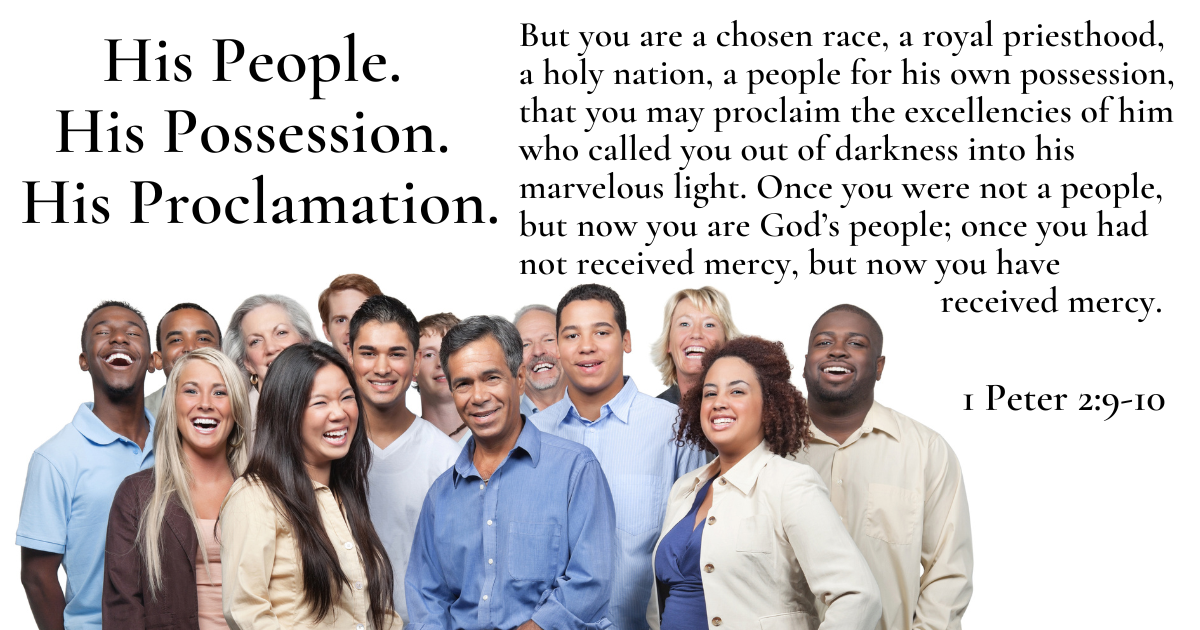
Scripture Reference: 1 Peter 2:9-10
Visit the series page: Exiles: A study in 1 Peter
-
Sermon Series: Spiritual Exiles
Message: His People. His Possession. His Proclamation.
Airdate: 9/28-9/29/25
Programs: 2366 & 2367
That's what we're gonna do. You know, we're in the thick of March Madness. And I have to warn you, I'm just seeing this as my, kind of green light to let my inner sports fan out in this message. So I'm gonna do that here. And, we're in March Madness, the NCAA tournament.
Maybe you've been watching it. Last night's game was crazy as one example, but so much fun. And and, I love, basketball in particular. Many of you know that. And, you know, as crazy as it is now, we we actually go back maybe, what, thirty years, and you're in the midst of the great dynasty of UCLA basketball.
You know, talk about how great teams are, Kentucky, etcetera, now. You wanna talk about greatness. You gotta look at at, UCLA coached by the great John Wooden. They won seven NCAA tournament championships in a row. He won 10 in total.
So back then, it wasn't hard to fill out your bracket. You just kinda went UCLA, UCLA, UCLA, UCLA, and everybody tied because everybody picked the same team to win the whole thing. That's the way that it was, a true a true dynasty. Once, they won 88 consecutive games in a row. 88.
Only to lose in the great state of Indiana. Playing who? Notre Dame. So we're gonna I'm amongst friends, sports fans, friends here. If you know that Notre Dame defeated them and broke that record.
But John Wooden just talk about John Wooden a second. You know, he was the iconic coach of UCLA. To this day, famous not only for his accomplishments, but he's quoted all the time. If you follow sports much, Wooden is quoted all the time. They call them woodenisms Because John Wooden had the ability to take kind of like life wisdom, sports wisdom, and just make it into a little statement that is easily remembered, easily quoted.
For example, “winning takes talent to repeat takes character.” Apparently, they had a lot of character in those days at UCLA. “It's what you learn after you know it all that counts” and things like that. So how great would it be if we could, hear John Wooden, like, at the halftime, speech or maybe in the huddle, ten seconds left. This is what we're gonna do.
He just had a unique ability to take big truths and to make them small and to make them memorable. And I love it when the Bible does that. You know, there's so much in the Bible you can kinda read and maybe it's ethereal. You scratch your head a little bit. But then there are certain passages of Scripture that just take it down and just say, this is what it's all about.
Right? Like John three sixteen. For the gospel, John three sixteen is a verse like that. This is the essence of the gospel is way more than this, but this is the essence of the gospel. Or, the role of Jesus, Colossians one eighteen, so that in everything he might have the supremacy.
Love that verse. Why? It just summarize it's like bottom line of bottom lines. This is what it's all about. Well, the passage we have in front of us today is a verse like that regarding the church.
Why are we here? What's our purpose? What are what's going on? This verse does it so wonderfully, so beautifully. It might be end up being your favorite verse in first Peter.
And so here we have Peter. He's part of the inner member of the inner circle. He's a leader of the apostles. He's a leader in the early church. Here we have the leader of the church telling us today, this is why you exist.
This is your purpose. Now get after it. K? Kinda like John Wooden would have done. So let me read first Peter two verse nine, and then we're gonna see what it's what it means.
But you are listen, church. “You are a chosen race, a royal priesthood, a holy nation, a people for his own possession that you may proclaim the excellencies of him who called you out of darkness into his marvelous light.” Very pastoral language by Peter here intended to be an encouragement. Remember, these, this letter is written to people that have been relocated. They are exiles in in Asia Minor.
They are sojourners in a culture that they don't know. They are struggling. And Peter wants them to realize that they have an identity that is different than what the people around them are saying who they are, what their feelings are saying about who they are. It doesn't matter what the culture says. It doesn't matter what your feelings say.
It matters what God says about you. And God has something to say about Christian identity and Christian purpose. I also want us to realize that this is not just for exiles, that this passage is for us today. If you're a Christian, this is you. He is describing you.
He is describing us collectively. Who are we? Why are we here? What is our purpose? You know, I can't help but notice that in the teams in the in the NCAA tournament, all of them, one of the first basic things is you've gotta know what team you're on.
Right? And so what do they do in order to identify what team they're on? They they all wear jerseys. And emblazoned on the jersey is the team, the university that they represent. And so they have, you know, Duke or Kentucky or the team about to lose to Kentucky.
You know, these are the identities of these teams in the tournament. And they all know who they are, though. If you're gonna be a winning team, you've gotta know, first of all, who are you? Who are we, church, in the eyes of God? Notice, you are a chosen race, a royal priesthood, a holy nation, a people for his own possession.
This is identity. K? Identity. One of the things that we know about all human beings is that we all we all crave an identity. In fact, we all need an identity.
We all need a place to belong. We all desire very much a sense of belonging. This is where I think our family or our hometown or the school we attended, these provide certain identities for us. One of the first things that, you know, when you meet somebody, what do you say? Where are you from?
And your identity is somewhat out of where you come from. This, I think, is part of the appeal of a lot of the of the sports teams and the sports mania where you watch these games. You watch a a Manchester United game or an Alabama football game, and you're gonna see a huge thousands of people all dressed in the same colors, wearing the same kinds of of, of jerseys. And they're in the stands. Right?
They are doing nothing really other than screaming to contribute to the victory or the loss, but they see themselves as connected to this team or this organization. And you can laugh at that, but people take it seriously. Like, they seriously are identified with that. The fortunes of that team up and down. Their emotions ride with the ups and downs of that team.
What is, I think, part of that appeal? We gotta belong to something. I gotta belong to something that is bigger than me, something that I think is really, really important. And in our culture, sports teams are one of the big identities that people attach themselves to. And, of course, this is all about relationship.
I wanna feel like I belong to something, that I'm in relationship with something that is greater than myself. In a sense, we're all that seventh grade boy standing in the cafeteria wondering where to sit. What table will accept me? Where can I go that I have a sense of belonging? Could I ask you, where do you belong?
What do you choose to identify with that gives you a sense of meaning in your life? What would you say is your identity group? This might be helpful. If you were to die today, what would people, your friends and family, what would they write about you in your obituary? If you read through obituaries, generally, they say this is so and so.
He's from this family. And he was an avid this. He was a part of this organization. This is the things that really mattered to him. What might your family say about you?
Or I do funerals and, you know, they'll have the casket oftentimes and the family and friends will adorn the casket with the things that were the identity of that person. And so there might be a picture of his dog. Or there might be, you know, his favorite sports team. There's a something from the team in there. Or it could be a Harley Davidson hat.
It almost doesn't matter. Right? Because the human heart craves, longs, and must find some identity with something beyond itself. We're made that way. We crave it.
We long for it. And, of course, the curse for all of our human identities is that they are all fleeting, and they are all temporary, and in the end, they are all disappointing. Right, Cubs fans? Right? Now that's a silly example, although some of you take it seriously.
I'm showing the superficiality of that. But all of our human identities, in the end, are fleeting. Even the most meaningful ones, family and marriage, we don't, in the end, get to keep those, do we? Why? Because death is separation from all of our human identities, everything connected to this world.
Death is the is the is the separation from that. If only there was somewhere, something that we could belong to that is real in this life and endures in the next life. If there was some place that I could have a sense of belonging, where I could feel like I have an identity and I could know that it's not bound up in the whims of sports or the marketplace or the stock market or human relationships or friendships or even family separated by death. Wouldn't it be great if there was some place that I could actually, not just theoretically, but actually see as my identity and to know that this will be my identity forever. Even death can't take it away.
Wouldn't that be fantastic? And that is essentially what Peter is encouraging these exiles with here. And he does so quoting mostly Exodus 19, and here he lists four blessed and enduring identities that are true for every single genuine and authentic follower of Jesus Christ. Let's walk through them together. First of all, he says, you are a chosen race.
A chosen race. We hear chosen and we think this has something to do with us. Right? Like LeBron who has tattooed giant across his giant back, chosen one. I think for LeBron, he means that to say something about him.
Right? He is the chosen one. And this of course was the stumbling block of Israel because God chose Israel. God chose Abraham, all of his descendants. And for all of those years in in in in spiritually speaking, it became a stumbling block because the Israelites thought their choosing was about them.
It said something about their worth. It was something about we're better than the other peoples. We're higher. We're special. And Moses in Deuteronomy wanted them to realize God didn't choose you because of you.
Here's what he says. “It was not because you were more in number than any other people that the Lord set his love on you and chose you. For you were the fewest of all peoples. But it is because the Lord loves you.” Did you hear that?
Why did God choose to love Israel? It had nothing to do with Israel. It is because God himself is love. The choosing has everything to do with God. And we here now in the new covenant, elect and chosen by God, sovereign choice election by God.
It does not give us pride. It does not make us think that this is about us any more than the donkey on Palm Sunday might have thought, they're clapping for me. They're wavy palm branches for me. Palm Sunday is not about the donkey and the church and the choosing is not about us. It is about God's sovereign love where he, for reasons only he knows, chooses to set his love upon undeserving, unmerited sinners like us and to say, I love you because I'm love.
And when God sets his love upon you and you respond to that love by loving him through the gospel, we enter into a a place. We enter into a a people group. God is forming a new people group. His chosen people. His chosen race.
We are a royal priesthood. That does not mean that we are kings and queens or princes or princesses. A priest in Israel was somebody that was allowed to draw near to God. A priest was somebody that ministered in the temple and offered the sacrifices and represented the people to God. God allowed the priest into a place that the people were not allowed to come.
We are now in the new covenant, a royal priesthood. We're not kings and queens, but God, the King, bids us to draw near to him. He allows us access into his presence. In the new covenant, my prayers offered in Jesus' name are heard in the very ears of God himself. We are we are close to him.
We are near to him. We're near to the King. We're royal priests. We are a holy nation. Listen to Grudem.
“Just as believers are a new spiritual race and a new spiritual priesthood, so they are a new spiritual nation, which is based now neither on ethnic identity nor geographical boundaries, but rather on allegiance to their heavenly King Jesus Christ who is truly King of kings and Lord of lords.” Do not miss the radical nature of even that statement. In a day where, especially in Israel, there was a sense that we are the people of God. We are the nation of God. And what does God come along and do?
And what does Jesus do? He dies on the cross not for just for the Jew, but also for the Gentile. Now all who believe in Christ are part of the nation of God, the family of God. We have a kind of citizenship. We don't immigrate.
We don't apply. Citizenship is by faith in allegiance to Jesus as Savior and Lord. And if Jesus is your Savior and Jesus is your Lord, then he is King of the nation that you're a member of. You become a part of that. And that means that there's no ethnic line on that.
There's no age line on that. There's no geographical line on that. The child living in the hut in Africa is as free to become a part of this nation as the wealthy Wall Street stockbroker is, and the educated Harvard person is, and the Eskimo is, and the Aborigine is. It doesn't matter who you are, where you are, what your background, your skin color, the blood in your veins. It matters if you believe and trust in Christ.
And if you do, welcome to the nation. Welcome to the nation. The nation of God. A fellow citizen with anybody else who has pledged allegiance to the King. We are part of a holy nation.
And fourth, and I think most wonderfully, these words here, that we are a people for his own possession. That Greek word there for possession is used describing the practice of the ancient kings of the East, who in those kings like kings now or presidents now, really any nation, has to pay for roads and swords and ships and provide various things for the people of that particular nation. And so taxes are taken in and it goes into the treasury. And out of the treasury of the the nation, those things are are met. But the ancient kings of the East would have they would have the monies of the country that while they were king, could lay a claim to those things.
Those were the things that were used to provide for the needs of the country. They had though a special treasury. A special treasury box, gold in that box that was not part of the national treasury. This was their own treasure. That word is the word that is used here.
We are, to God, a personal treasure. We are, to God, a personal possession. This is about relationship. We belong to him. We belong to almighty God, a treasure to the most high God.
Here's just two verses that talk about this. Isaiah forty-three one, “Fear not, for I have redeemed you. I have called you by name. You are mine.” Titus two, “who gave himself for us to redeem us from all lawlessness and to purify for himself a people for his own possession who are zealous for good works.”
Indeed, we are the possession of God. How? He bought us. He paid the ransom price for us, didn't he? He bought us out of the slavery of sin.
The blood of Jesus was the ransom payment. We are redeemed. We are bought back by God, and now we are the very possession of God. But like in your house, you have possessions that are in different categories. You probably have things in your garage and things in your basement you don't even realize that you have.
Right? And so you hear it's it's time for the neighborhood garage sale and you go rummaging through the, you know, the basement or the attic. And you're like, oh, I forgot all about this thing. Right? You have those kinds of possessions.
But then there's the things that you hide when you go on vacation. That's in a different category, isn't it? What do you hide? You hide things that are dear to you. You hide things that are valuable to you.
You hide things that are special to you. What this passage is saying is in God's eyes, that's what we are. He cares for us. We are dear to him. We are his personal possession.
We are his personal treasure. Take these all as a whole. Chosen nation, priest of the King, prized by God himself, think of what this would have meant to the people that Peter's writing to. These exiles who are living in this you know, they're like men without a country. They don't they don't They've been they've been geographically displaced.
They've been they're displaced from their families, probably their jobs. They're living in a a place where the people around them are viewing them negatively, are seeing them suspiciously. They're suffering loss. They feel just so isolated. They wonder, who where do we belong?
Like, who am I? Why are we here? What is this all about? Think of how encouraging this would have been for Peter to say, listen, you are you have an exalted status. That we are not who our feelings say that we are.
We are not who other people say that we are. We are not who our pain and our trials in those moments say that we are. Who are we? We are God's chosen and prized possession. We belong to him.
What better news could we hear? Right? Christian, what better news than to be loved and treasured, to be citizens of the only nation that will endure the test of time, to be members of the family of God. Now how important is this? I think it's critical.
My dear friend, I think it's critical. I had a woman right before first service today comes up to me and said, would you please pray for me? Tears in her eyes, suddenly lost her job, struggling with what that means, worked twenty two years in this company, and just boom, you're done. And just, you know, that that kind of startle, that kind of struggle, we can relate to that, can't we? But that's life, isn't it?
Life in this world and all of these identities that we sort of cling to and want to make us feel like, you know, we belong to something, they're always fleeting and they're always changing. So make your identity your husband or your wife, and then death or divorce comes. Now who am I? Who am I? Make your identity your children, and then their rebellion shatters you.
Make your money your identity, and then a recession destroys you. Make your health or your good looks your identity, and then feel the creeping effect of age and look in the mirror and think, who am I? These and so many other things like this. All the time, fleeing. We never get past being that seventh-grade boy in the cafeteria.
Who am I? Who accepts me? Where do I belong? And to this, God shouts to his people. He shouts to us, Bethel Church, and you Christian.
He wants you to realize who you are, your identity, your place, your sense of belonging, that you are prized by God himself. I like that. I like that. I think about our young people here. We've got young people.
I see them sitting around here. Teenagers. Those years where you're just like, oh, who am I? And all of that. And the culture shouting at you the things that really, this is where your identity should be, and the friends at the school saying, is what's really important.
Would that Bethel Church would be a vehicle to raising up a generation of young people who refuse to find their identity in the fleeting things in this world? And even as young people say to themself, I am a child of God. And I don't look like you say I gotta look. And I'm not doing the things that you say I gotta do. And I'm not caring about the culture things that you say I gotta care about.
Because I know who I am. I'm a child of God. I'm gonna live out that identity. Wouldn't that be great? And for their parents as well.
For their parents as well. So our identity is that we are God's possession. But notice that we are not simply in identity to be in identity. Rather, there is something that we are to do. It's the rest of the verse.
That you may proclaim the excellencies of him who called you out of darkness and into his marvelous light. What a wonderful verse this is. We are God's possessions, and our purpose is proclamation. In other words, we don't exist for ourselves. Can I say that, Bethel Church?
This church does not exist for Bethel Church. And Christian, this church doesn't exist for you. This is not about you primarily. So enough of the, you know, this church, you gotta do this for me and this for me. Enough coming to church like a consumer.
Go to the mall. This church exists to proclaim the greatness of somebody else. Indeed, we are proclaiming him, the text says. How wonderful he is. To proclaim how wonderful it is, what God has done for us, taking us out of darkness and into his marvelous light.
Darkness throughout Scripture is a metaphor for mankind apart from God. The life of man, the philosophy of man, the worldview of man, living out his life apart from a relationship with God. The Bible says that that situation is like a person walking around in darkness. Jesus said it this way. After and this is the judgment.
“The light has come into the world, and people love the darkness rather than the light because their works were evil. For everyone who does wicked things hates the light and does not come to the light, lest his works should be exposed.” Many other passages of Scripture say this same kind of language. It describes humanity, some in darkness, some in light. But those that are in darkness, really, it's it's not so much that we're in darkness, it is that we are in blindness.
The light is all around us. Right? We just can't see it. Romans one twenty, “the very nature of God is on display in the things that have been made so that men are without excuse” What is that describing?
It's saying that in this whole world of of of beauty and of color and of flavor and of visual delights and sensory delights and sunrises and sunsets and, experiences that we enjoy. All of these things are is God communicating to us something about himself. God is shouting, “the heavens declare the glory of God,” Psalm 19. So every day, it's pouring forth speech that Psalm says. God is shouting and saying, I'm here.
This is what I'm like. This is who I am. But the natural man, because of sin, born in sin, born in darkness, is blind to the light. You could take a blind person out on a blazingly sunlit day, and to him, it's all darkness. Right?
You can say, no, the light's shining. Said, no, it's not. I can't see it. It's there. I can't see it.
Our problem morally and spiritually, naturally is that we are blind to the things of God. We are blind to the to the gospel. We are blind to the glory of God. We're we're blind to our created purpose. We are we think that we see.
Right? But we don't. As one person described the philosophies of of man like a blind mind a blind man searching in a dark room for a black cat that isn't there. I quote I just did that by memory. One more service to go.
So you look at the world around us. Right? Professing to know truth. This is what's really important. Living for all kinds of things.
The Bible says that's all darkness. They are trying to explain reality. They are trying to explain the world around them, but they have no reference point with God. And so they are in their blindness and in their darkness. That's secular humanism, trying to explain purpose without God.
That's evolution, trying to explain existence without God. That's the world around us. Right? That's what they are. They're and they're living out that moral worldview aka Daytona Beach Spring Break.
Where does no reference point with God lead to? It leads to despair. So you drive a jet into a mountain with a 100 plus people in the plane with you, or you go to Daytona Beach and you take your clothes off and you dance. That is mankind's condition apart from God, seeking for meaning, seeking for some answer. It's darkness.
It's blindness. And that's where all of us begin. But then something happens. Something happens. Somehow, there is a light that shines into the awareness of the sinner.
It is a light of truth. It has something to do with Jesus who said he is the light of the world. Right? He shines into the awareness and the understanding of the person in darkness, and there is a kind of apprehending of what Jesus has done, an entire way of thinking that is different than the darkness. This is light thinking and an awareness of my sin and my guilt.
I come to see that Jesus has come and died on the cross in my place bearing my guilt and my shame. And I hear in the gospel message God saying to my own heart, you are a sinner, but if you put your belief and your trust in Jesus and what he did in your place, I will forgive your sins, and I will welcome you into the light. And for the sinner, it's like it's like the scale like, you know, the blinders come off. And now I see the truth. I see the light.
And by faith, I leave the realm of darkness, and I step into his marvelous light. That is salvation. That is conversion. That is the gospel. And if you're a Christian here today, maybe you can't remember what it was like living in darkness.
Maybe you can. But how good it is to be in the light, in the marvelous light of the truth. The marvelous light of the presence of God. The marvelous light of the favor and the love of God. The marvelous light of his grace.
To look back at the way that it was and to say, “I once was lost, but now I’m found. Was blind, but now I see.” To be in the light. Praise God that he welcomes sinners into the light. Here is second Corinthians four six.
“For God, who said, ‘Let light shine out of darkness,’ has shown in our hearts to give the light of the knowledge of the glory of God in the face of Jesus Christ.” What that text is saying is that just like God spoke into the darkness of the abyss of nothingness and created light in creation, he does that every time he speaks into the heart of the sinner. He speaks light. Let there be light. And the sinner sees the light of God shining in the face of Jesus Christ.
I come to realize who he is, and I make him my Lord and my Savior. I surrender my life in faith to him. Now here's the purpose. Notice the purpose. Praise God that he's done that.
Praise God we're a holy nation, royal priest, and all of that. But why are we here? The verse tells us that you may proclaim the excellencies of him who called you. Church, why do we exist? We exist to proclaim, to declare, to make known this light, this glory that we have ourselves so preciously embraced.
Now look at that word excellency there. Okay? This is one of the scholars. They say it's hard to translate this word. I take them at their word.
They know more about that than I do. But I think we have a little clue here about what it's talking about. If you look just back to verse three of chapter two, what does it say there? It says, if indeed you have tasted that the Lord is good. That word for good in verse three is the same word that we find for excellencies in verse nine.
So in verse three, we are tasting the goodness of God. In verse nine, we are declaring the goodness of God. K? So in verse three, we taste it. In verse nine, we tell it.
What's our purpose? Well, here we have, I think, the clue and the key. We essentially are doing with this most marvelous experience of salvation what we do with anything and everything that we delight in. To give you an illustration of this, some weeks ago, I we were on vacation, and we were visiting Jennifer's parents. And so one of the days, I had a lunch to myself, and I didn't know the area.
I didn't know the restaurants. I just needed to find some lunch. So there's one of these strip malls with various restaurants, and I just parked and said, okay. I'll go to this one. So I went walking into this restaurant.
The name of the restaurant is Zoe's Kitchen. K? Zoe's Kitchen. I go walking in, and I'm like, oh, this looks kind of nice. Kinda had sort of a chipotle feel to it inside.
And, it had a big sign, you know, fresh only fresh ingredients used, something like that. And I thought, oh, well, that at least it'll be fresh tasting. You know? I have no idea what this place is about. So I go walking up, and I stand in front of the counter, and and I'm looking there.
It's one of those moments if you've ever been to a restaurant first time, you know, you're kinda like overwhelmed by the experience. I'm looking at all these options. And the guy that's working there, he's I said, it's my first time. He goes, well, our shish kebabs are good. Well, I happen to like shish kebabs.
So I was like, shish kebabs it is. I'll take the shish kebabs. And what sides would you like? And here's a list of the sides. And I'm like, I'll take the mixed vegetables, and I'll take the fruit.
Coming right up. So I paid the bill. I went and sat down, waited for them to bring, the food by. And I'm just, you know, taking it in. It's kind of a nice environment, playing on my phone.
Here comes the food. And they delivered the food and put it in front of me. Here you go. Thank you so much. And I looked down.
I got my phone, and I take the first shish kebab, and I'm like, It was fantastic. I'm serious. It just was one of those like, wow. I'm like, you know, it's got like chicken, tomato, mushroom, chicken, tomato, mushroom. One of those kind of things.
I'm just pulling each one off and going, enjoying it so much. I get I think I got to the end and I'm like, lick the kebab. I've got a whole another one to enjoy. Right? So I'm I just it was so good.
You know, here I am at kind of a In N Out sort of restaurant. This isn't exactly fine dining. And the food was fantastic. So I get done with all of that. I was like, wow.
That was just awesome. Well, now I have the mixed vegetables. So I get eating the mixed vegetables. And they had that kind of like grilled, you know, sort of flavor to them done just perfectly. I was like, this is so good.
These mixed vegetables are great. Finally, I have the fruit. And I took the pineapple and the strawberry and the blueberry. And all of them had that kind of midsummer freshness flavor to them. I'm you know, this is like February, but it's tasting like July.
And I just I got done with the whole thing, and I just thought, that was wonderful. I called the manager over. I could tell me about Zoe's Kitchen a little bit. I'm thinking, I need to open one of these in Northwest Indiana. And if there are any investors here that would like to talk to me.
But I got all this information. I looked it up on my phone really quick. Zoe's Kitchen. You know? I'm like, there's a stock there.
What you know? It's like, I was utterly impressed. I drove home. Jennifer and her family there, I go, Zoe's kitchen. It's fantastic.
You gotta I just told her about all of this. I talked about it for three days. Of course, we had all had to go back over there for lunch. Everybody ordered the shish kebabs. I mean, it was just it was just one of those fun surprise moments.
I couldn't get over it. It was just so good. What did I do? I tasted goodness, and I declared goodness. That's what we do with anything we delight in.
What a great game. Did you watch that game last night, Notre Dame, Kentucky? Oh, man. Right down to the wire. What a great game that game was.
What a beautiful sunset. Take a picture. Let's put it on Facebook. Let's talk about this beautiful sunset. Isn't it wonderful?
Have you been to that new restaurant down there? Man, the food there is great. You've gotta you've gotta go and check that out. My daughter is so beautiful. Let me just talk about my daughter ad nauseam.
This is the human heart. We are made to declare anything we delight in. In fact, the more that we delight in it, the more we wanna talk about it. Right? Listen to CS Lewis on this.
The world rings with praise. Lovers praising their mistresses. Readers, their favorite poet. Walkers praising the countryside, players praising their favorite game, praise of weather, wines, dishes, actors, motors, horses, colleges, countries, historical part personages, children, flowers, mountains, rare stamps, rare beetles, even sometimes politicians or scholars. Except when intolerably adverse circumstances interfere, praise almost seems to be inner health made audible.
I had not noticed either that just as men spontaneously praise whatever they value, so they spontaneously urge us to join them in praising it. Isn't she lovely? Wasn't it glorious? Don't you think that magnificent? I think we delight to praise what we enjoy because praise not merely expresses but completes the enjoyment.
It is its appointed consummation. And my friends, that is the key to what Peter is describing as the purpose for which we exist. The purpose for which this church is here. And Christian, why you are on this planet? What are we called to do?
We are called to delight, first of all, in what God has done for us. To delight in the fact that I was in darkness, and if I had stayed there, I was going to hell forever and ever and ever and ever. But God chose to send light into my darkness. God chose to love me through Jesus. God chose by the Spirit to help me realize what he has done for me.
And in the doing of that and my response in faith, I left the darkness. I came into light. And not just light, marvelous, wonderful, glorious, life giving, eternal light. And to so delight in what God has done for me that I declare it. I declare it with my life.
I declare it with my words. I declare it with the church. I declare it with my small group. I declare it in my family. I declare it with my thoughts and my prayers.
My life now is living out my delighting in what God has done. And the more I delight in what God has done, the more I want to declare it. He who has loved little, loves little. He who has loved much, loves much, Jesus said. So why let me ask let's ask this question.
How can there be so many professing Christians who have experienced the love of God taking us out of darkness and into light, but their lives declare nothing? Silence or worse yet, still living for the values of the darkness out of which God has brought us. And the world around us wondering, wow, why? What is there to what you're saying? You live just like we do.
How can we be silent? How can we not say something? Could it be that we are not delighting? We're not humbled. We're not in awe of the grace of God to us.
Because when I realize what God has done for me and I delight in what he has given to me in salvation and I stand in the light of his forgiveness and his grace and eternal life, How can I but say something? Now you might be like, oh, here we go. Gotta go on a street corner and say something. I gotta knock on the door next to me and say something. Something I get I gotta get cheesy.
That's not what Peter does. What does faithfully declaring the goodness of God look like for Peter? Look ahead. He begins in verse 13. It looks like being submissive to authority that God places over you.
Chapter three, it looks like an unbelieving a a believing wife married to an unbelieving husband, faithfully living out the gospel in the home and winning his heart to the gospel without words. That's what it looks like. It looks like in chapter three beginning in verse eight, Christians enduring even unjust suffering for Jesus' sake and remaining faithful in the trials of life. And on we can go in Peter. That is faithful presence.
That is delighting in God more than the identities of this world. That is what it means to be salt and light. And to live in this dark world, desperate for truth, wondering what life is all about. And to, yes, say it, but also to live it and to be found faithful in the doing of it. But we have to know who we are.
We have to know whose we are. We have to delight in what God has done, and then we we delight to declare it to all who will listen. Hosanna. There is a Savior. Hosanna in the highest.
Bethel Church, let's just do that. Can we just do that? Can everybody get on board with that? Can we remind our souls what God has done for us? Can we relish the marvelous light and then simply invite people to Zoe's kitchen?
Come sit at our table, seventh grade boy, looking for somewhere to belong. You can belong here. Red and yellow, black and white, they are all precious in his sight. All are welcome to the nation of God. Amen.
Would you stand with me for prayer? God, I pray over our church right now. I could pray for any church this truth, but God, we are responsible for this one. Father, forgive us for our silence. Forgive us for forgetting what life was like in darkness.
Forgive us, God, for minimizing the glory of walking and living in your marvelous light. And I pray that the gospel would bring us back to this basic point that we are great sinners, but Christ is a great Savior. And from that might flow our purpose, to declare the goodness and the excellencies of him who has loved us and saved us. And, God, I pray that we would indeed live for your glory. We are happy to be the donkey.
We are happy to carry Jesus in glory before others, to wave the branches, and to sing over him. We pray this in Jesus' name. Amen. We're gonna sing a final song, but before we do, just a word. Are you in the light?
Are you in the light? Like, as I described that living in darkness, now living in the light, and the scales coming off, and the apprehending of the glory of God, and the face of Jesus. Are you in the light? God bids you, welcomes you into his family, into his nation, into his treasure box. The condition is faith.
You must believe. And if you have not believed yet, why not right now? Why not put your faith in Christ right now and step into the light?
* This transcript was generated using AI transcription technology and reviewed for accuracy but may contain errors. Please refer to the original audio for precise wording.