Scripture Reference: Nehemiah 12:27-43
Visit the series page: 3E Christianity
-
Sermon Series: Stand-Alone Thanksgiving Message
Message: Celebrating What God Has Done
Airdate: 11/24/2026
Programs: 2407
Celebrating What God Has Done Part A
Well, we are moving into our week of Thanksgiving. Of course, for Christians, every week should be a week of Thanksgiving, don’t you think? So we’re going to talk about that a little bit here. And if you have a Bible with you, you’re going to want to open it to Nehemiah 12. But I would also open to Ephesians 5 and maybe put your finger there. We’re going to be comparing two passages of Scripture, one from the Old Testament, one from the New.
We were in Nehemiah 3 and we took a look at what it looks like when God’s people come together, they unite for a common goal and a common task. In this case, it was the rebuilding of the wall of Jerusalem. When Nebuchadnezzar came in 586 BC, he came to Jerusalem and he just wiped it out and he tore down the wall and he deported people. And for 140 years, that wall... remained in its condition of being basically all broken down. Nehemiah comes along. God gives him a vision and a passion to rebuild the wall. He goes to the people. He says, “Let us rise and build.” The people motivated now by this common vision. And we know that it was a God thing. They set about to rebuild the wall, which they did in 52 days. And this was in spite of decades of indifference about that wall being in that condition. It was in spite of opposition. There was criticism, death threats against Nehemiah and all the rest. And yet everybody was on the wall. Everybody was building. Everybody did their part.
And Nehemiah 6 records the moment of when the wall was finished. It says this, “So the wall was finished on the 25th day of the month of Elul in 52 days. And when all our enemies heard of it, all the nations around us were afraid and fell greatly in their own esteem.” That’s an interesting statement there. They fell greatly in their own esteem, “for they perceived that this work had been accomplished with the help of our God.”
From that passage and from the story of Nehemiah, we come to realize that if you think that Nehemiah is about the wall, it’s kind of like thinking that Jonah’s about the whale. Nehemiah is not about the wall and Jonah is not about the whale. Rather, it’s about what happened to the Israelites while they were on the wall, like what happened to Jonah while he was in the whale. Namely, that there was actual true revival and renewal that God worked and the people of God there as they were rebuilding this wall. It was nothing short of a mass national revival, and the wall was symbolic of God rebuilding His people.
If you read through Nehemiah, if you kept going from chapter three, they finished the wall. They have two national worship services. One, the word of God is preached, and they stood all morning long, and they listened to the word of God being proclaimed to them. And they said, “We are going to do that.” And as an example, they celebrate the feast or the festival of booths for the first time since the days of Joshua. Renewal, revival, repentance. They gather again for a national confession. They confessed the sins that caused God to bring the Babylonians in the first place. And they said, “We confess that to You, God. We want to be restored.” And they were.
And the story of Nehemiah is, Nehemiah shows up in Jerusalem, the walls are broken down, there’s no worship going on, everything’s in disorder. By the end of Nehemiah, the wall has been rebuilt, worship has been restored, the priests are back, the Levites are back, the sacrifices are back, leadership is restored in Jerusalem, and it’s a picture of God’s covenantal people being restored to a proper life and worship there in the city of Jerusalem. A picture of redemption. Aren’t you glad God’s a God of redemption, by the way? And don’t we find even in that story a picture of what God does in each one of our hearts, spiritually, in our lives, as sin breaks the wall down and brings all kinds of destruction. But when God comes by His Son and by His Spirit into the heart and the life of an individual, things are set aright. Worship is set aright. The heart is set aright. God is once again King and Lord over our hearts.
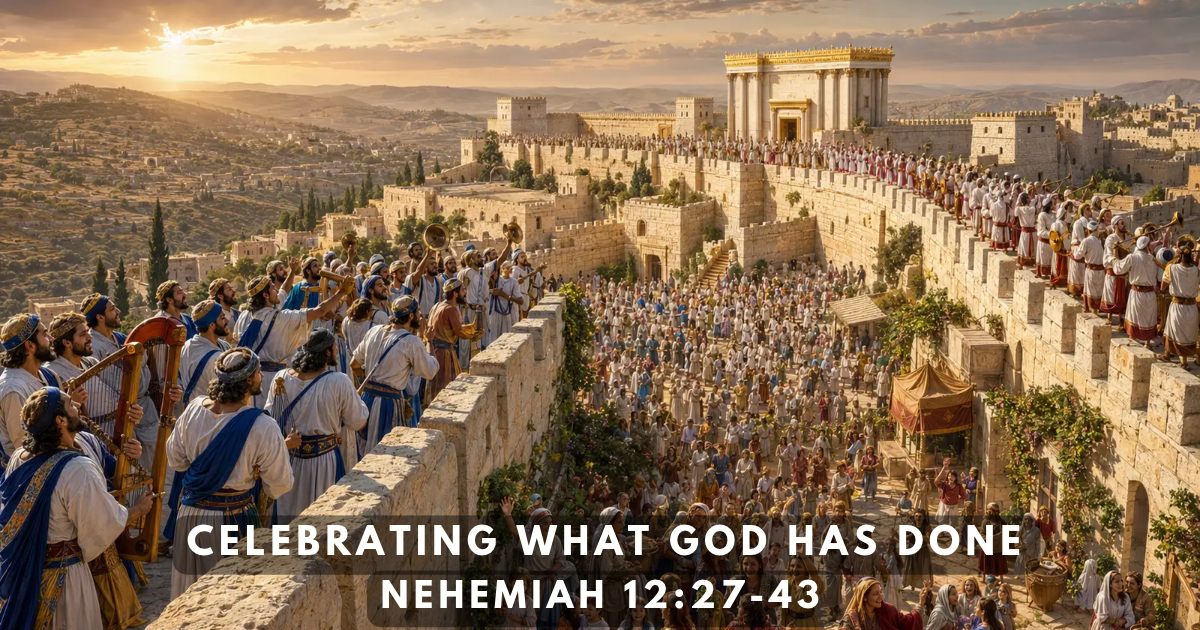
The high point of the story is in chapter 12, and that’s what we’re going to look at right now, where they gather again, only this time it is to dedicate the wall to the Lord. I begin reading in verse 27, Nehemiah 12, verse 27. “And at the dedication of the wall, they sought the Levites in all their places to bring them to Jerusalem to celebrate the dedication with gladness, with thanksgivings, and with singing, with cymbals, harps, and lyres. And the sons of the singers gathered together from the districts surrounding Jerusalem and from the villages of those people. Also from Beth Gilgal and from the region of Geba and from Azmaveth. For the singers had built for themselves villages around Jerusalem. And the priests and the Levites purified themselves, and they purified the people and the gates and the wall. Then I brought the leaders of Judah up onto the wall and appointed two great choirs that gave thanks. One went to the south on the wall to the dung gate. The other choir of those who gave thanks went to the north, and I followed them with half of the people on the wall above the tower of the ovens to the broad wall.”
And the picture that Nehemiah describes here, this worship service, it was kind of like a parade. They divided into two groups. Half the choir went one way around the wall. The other half went the other way around the wall. And they were expressly giving thanks as they went. And they went all the way around. And they arrived in one, probably the temple courtyard there. And they gathered together. And they have this big, massive, joyous, glad worship service where they celebrate the wall being done.
Now, I got thinking about what that must have been like, because these are the people that are on the wall and are singing are the same people that built the wall in the first place. And so imagine as they’re walking along, and here you have some Levite or whoever, and he’s, “Oh, they’re coming up to my section, the section that I built. Oh, here it is. This is my section which they walked across.” I’d be thinking to myself, I hope it holds. I don’t want to see Nehemiah fall to his death because I’m a perfume maker and don’t know the first thing about building a wall. But the wall held, and they made their way all the way around. And the picture here is of a joyous celebration for what God had done. And the text says that they dedicated the wall, and they dedicated the gates, and they dedicated the doors, and they dedicated themselves. And that is the most important aspect of what happens here. They dedicated themselves.
The 150th anniversary of the Gettysburg Address, did you guys see some of the hoopla about that? I love history, and so I watched an actor portraying Lincoln give the Gettysburg Address. And I can’t quote it, but one of the things that Lincoln said in the Gettysburg Address was something to the effect of, we do not come here to hallow these grounds. These grounds hallow us. The blood that was spilled here by the men who gave their lives will forever be hallowed. I thought it was such an interesting way to describe it. And it’s kind of what’s going on here in this wall. They weren’t so much dedicating the wall as the wall was dedicating them, or in this case, God was rededicating them to Himself as the people of God once again.
So to build it, everyone was on the wall. To celebrate it, everyone was in worship. And the picture in verse 43 is one of overflowing gladness. “And they offered great sacrifices that day and rejoiced, for God had made them rejoice with great joy. The women and the children also rejoiced, and the joy of Jerusalem was heard far away.” The emphasis here is on joy. Did you hear it there? The text says God made them rejoice with great joy.
How satisfying it must have been for them, because everybody had helped build the wall. And now here they’re all there, and they’re celebrating that the wall was done. Everybody had a role, everybody had a part, and then everybody worshiped. And it just seems to me this is so often the way that God works in our lives, is that the toil and the labor comes first and then the celebration. Or as my dad told me growing up, “Steve, work first, then play.” Any of you guys have dads that say things like that to you? That’s what my dad would say to me. “Work first, then play.” And it seems like spiritually that we carry our cross before we have the celebration. Or that God puts all of our resurrections after our crosses.
And some of you today, no doubt, you’re in that cross time. You’re carrying a burden. You’re carrying a cross. You’re in a trial that God has brought to you, and you’re wondering if this is ever going to become something that is once again glad or joyous. I want you to see in the story of Nehemiah and, of course, in the story of redemption through Christ, that for us, all our trials are temporary. All our trials are temporary. Because someday, God is going to remove all those trials and redeem all those trials. For the unbeliever, trials are never ending. There are trials and troubles in this life. And after judgment, there is eternal trouble from the wrath of God. But not for us, not for a believer. They are all temporary. There is a party coming.
Now note the features of this celebration. First of all, dedication to God. We see that in verse 30. “And the priests and the Levites purified themselves, and they purified the people and the gates and the wall.” Dedication to God. Secondly, it says there was music and song. Did you pick that up? Look again. Verse 27, there’s singing, cymbals, harps, and lyres. Now, a harp was basically more like guitars that we would call today, and lyres were kind of like mandolins. So sometimes we look in the Bible, and any time we see music, we think it’s like the Philharmonic or something. “Oh, it’s like the Chicago Symphony.” No! No, not at all. Cymbals is percussion, guitars and mandolins. This was bluegrass, essentially. And we know that dancing to this day is a huge part of Jewish culture and celebration. So no doubt there are dancers there. You got the choir, you got the music, you got the bluegrass. This was a hoedown, is what it was. As they went around and they were just dancing and partying and celebrating. “Look at the wall. The city is back. We are back. God is back.” Back in Jerusalem.
Which leads then, I think, to one of the most distinguishing marks here, is that there was tremendous joy and tremendous thanksgiving. Again, verse 27. The whole purpose behind gathering was that they would celebrate with gladness, thanksgivings, and singing. And then we get to the end of the narrative, and it says that God made them rejoice with... joy. And we see that this celebration, it was not sort of a manufactured gladness, like we got to pretend that we’re happy about this. Nobody had to smoke something or drink something to get in the mood to celebrate what God had done. It was God-empowered gladness as the people of God realized the work of God through them and building the wall, and they were glad in God, and God was glad in them. And they partied and celebrated.
Have you ever been around a football stadium, a packed-out football stadium, and then the home team scores a touchdown? Now, when the visiting team scores, it’s like crickets, silence. But when the home team scores, right? And if you’ve been, you can be a mile away from Notre Dame Stadium or Soldier Field or something, and when they score, it just echoes, doesn’t it? And you think something big just happened. The home team scored. That’s what was going on here. The text says that their joy and gladness was heard a long way off. Everybody that was hearing that was, “Something big’s going on. What has happened?” The wall is done. Jerusalem and the people of God are restored. They are dedicated to God. So a great moment in redemptive history there.
Now, here today, we’re not on a wall and we’re not in a temple, and we can look at this and say, “Okay, a party 2,500 years ago, what relevance could that possibly have for us or for me today?” And this is where we see in Nehemiah 12 a picture of what every day can be for the new covenant Christian. And this is Ephesians 5. I told you to put your finger there. Slide over to Ephesians 5 and listen as I read the text, because I think you’re going to hear a very parallel statement and description of what New Covenant joy and thanksgiving is all about.
Ephesians 5, I begin in verse 18. “And do not get drunk with wine, for that is debauchery, but be filled with the Spirit, addressing one another in psalms and hymns and spiritual songs, singing and making melody to the Lord with your heart, giving thanks always and for everything to God the Father in the name of our Lord Jesus Christ.” Now this is one long sentence here in which the Apostle Paul says, Christians, there’s something not to do. And then he gives a list of several things that we are to do. He begins by saying, “Do not be drunk with wine, but be filled with the Spirit.” No, to control by alcohol. Yes, to control, or what he calls filling, by the Holy Spirit.
Now let me give you just a very quick, very quick theology of the Spirit here and what filling is talking about. When a sinner hears the gospel and responds in faith and truly believes in Jesus as Lord and Savior, the Bible says that God bestows upon that new Christian all kinds of blessings. We’re adopted into His family, for example. We’re given the gift of eternal life. But one of the things that God does is He sends His Holy Spirit to that now Christian in such a way that the Bible says the Spirit dwells within us. To be a Christian is to have God, the Holy Spirit, His presence with us. He dwells within us. This is known as the indwelling work of the Holy Spirit. It is a sign or a seal, Ephesians 1, that we are actually saved. It’s a gift from God to us, a foretaste of the greater glory that we’ll receive someday when we die and we step into eternity. It is a precious gift.
So we have the Holy Spirit within us. And the Bible says that that is not just something like... having a new credit card in your billfold or something. It is a transformational thing to have God dwelling within you. So much so that it actually produces things in our life that are observable. Just like with alcohol, we can tell when somebody is under the control of alcohol. And if you don’t know what I’m talking about, buy a Bears ticket and you’ll be enlightened. We know what that looks like when somebody’s under the control of alcohol. What does it look like when somebody is under the control of the Holy Spirit? The Bible says this is what it looks like, Galatians 5. It looks like “love, joy, peace, patience, kindness, goodness, faithfulness, gentleness, self-control.” The Spirit brings those qualities into our experience.
And all of them sound good to me. How about you? Who doesn’t need a little more love? Or who wouldn’t like to have a little more peace in their life? We all want that. And what a blessing to realize the reason that’s the fruit that the Spirit bears in us is that’s what God is like. He is love. He is joy. He is peace. He’s patience and all the rest. So when God gives us His Spirit, God produces in us His character, His qualities, which are eminently desirable and wonderful.
So, the fruit of the Spirit. Filling, then, is that work of the Spirit whereby as I yield my life and surrender my heart and my desire to the things of God and to God’s plans and purposes, the Holy Spirit fills me, He controls me, and He bears His fruit through me. Filling, therefore, in our experience, is something that can fluctuate. For some of us, you know, between Monday and Tuesday, we can grieve the Holy Spirit by willful sin, and sin of the high hand, rebelling against God, grieves the Holy Spirit, and our experience of His blessing and fruit in our life is diminished. But when I repent and I yield and I surrender and I obey, now my life is increasingly controlled by the Spirit, and His fruit and blessing is more experienced in my life. It can fluctuate, the filling of the Holy Spirit. As is famously said, “It’s not a question of whether I have the Holy Spirit. The question is whether He has me.” And the degree to which He has me is then filling, filling of the Holy Spirit.
Now, what does that look like? I gave you the Galatians 5 passage, which is the famous fruit of the Spirit passage. Ephesians 5 is maybe a secondary fruit of the Holy Spirit. What does it look like when a church is filled with the Spirit? Or when a Christian is filled with the Spirit? We have this description, and boy, it sure sounds a lot like Nehemiah 12, doesn’t it? Again, what was Nehemiah 12? Dedication to God, song and praise, joy, and thanksgiving. What does Paul say here in Ephesians 5? It’s almost the same, isn’t it? It’s almost the same. So let’s just compare this now. On the wall, dedication to God. In the church, filling with the Spirit. Similar concept. On the wall, there was joy and thanksgiving. In the church, there is joy and there is thanksgiving.
And it shouldn’t surprise us that a Spirit-filled Christian is a joyous, a glad, and a thankful individual. This is what God is like. And to talk specifically about joy, is your understanding of what God is like, do you realize He’s a glad God? God is the most joyous person in all the universe. Some of us, we think of God and we think He’s sad. Because all the people that we know that follow Him, they’re also sad. They’re so melancholy. Why? “Because I’m godly. I’m godlike. And that’s why I’m sad all the time.” No. God is a God of joy and gladness. Psalm 16:11, “In Thy presence is fullness of joy, and at Thy right hand are pleasures forevermore.” And we need to get out of our mind some kind of concept of God that leads us to sadness. God is a God of joy and gladness, and He gifts us with the same.
I love C.S. Lewis. His writings have been profoundly impactful to me. And I commend him in every respect for you to read him. So much so a hero for me that Jennifer and I took a baby moon. Now I don’t know if you know what a baby moon is. Like honeymoon is what you do after you’re married. Baby moon is what you do before the baby arrives. A trip or something like that. Because once the child is here, there’s no more fun. You better do it while you can. So we went on a baby moon trip. One of the goals of the babymoon trip was that we wanted to see the grave of C.S. Lewis. And there’s a whole story behind that. It involves a pregnant woman running through the mud and the rain, but I digress. It’s a funny story.
But we finally got to where his grave is at. He’s buried in the little cemetery next to Holy Trinity Church, this little church. Literally, it was like a path that we had to take to get to the church. We were in a hurry. The cab was waiting for us. Its ticker was rolling like that. We’re like, “We gotta go quick. We gotta go quick.” And we got up there, and we’re like, “How are we gonna find this grave in the midst of all these other graves here?” And I saw a little bitty sign that said, “C.S. Lewis grave,” with an arrow. I said, “It’s over here.” And we went running over there, and we actually found a very special man. And one of the things that Lewis wrote about so poignantly and powerfully, 50 years later, he’s still a best-selling author, is the whole subject of joy. Amongst the things that he said, “Joy is the serious business of heaven.”