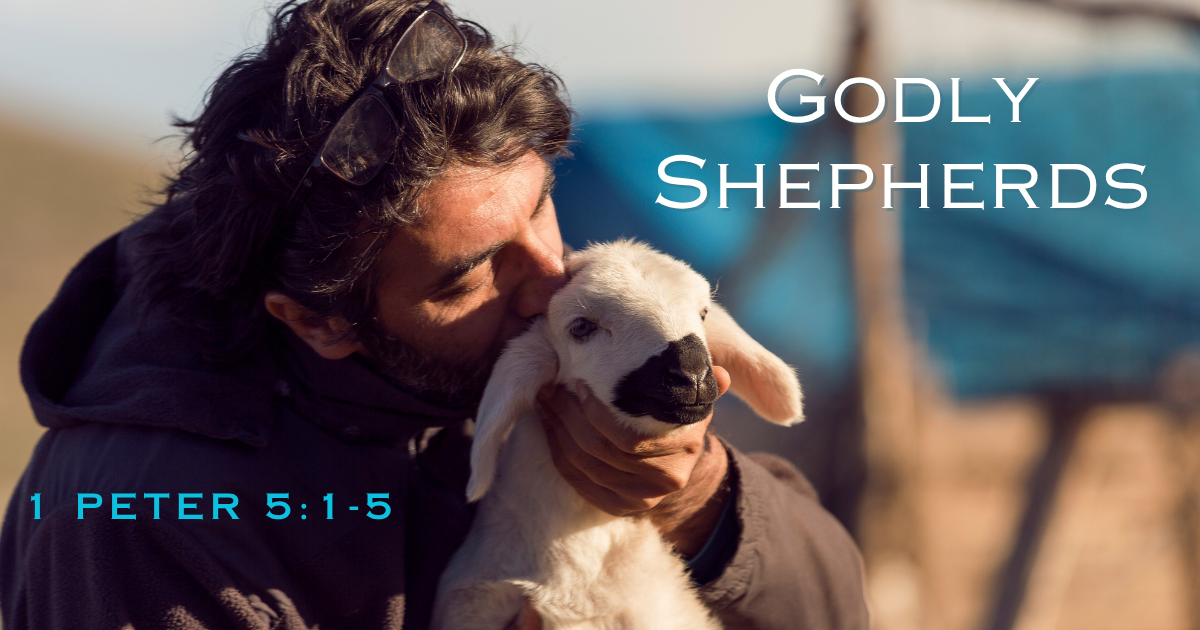
Scripture Reference: 1 Peter 5:1-5
Visit the series page: Exiles: A study in 1 Peter
-
Sermon Series: Spiritual Exiles
Message: Godly Shepherds
Airdate: 11/4/2026
Programs: 2393
Godly Shepherds Part B
1 Peter 5, verse 1. “So I exhort the elders among you as a fellow elder and a witness of the sufferings of Christ, as well as a partaker in the glory that is going to be revealed. Shepherd the flock of God that is among you, giving oversight, not under compulsion, but willingly, as God would have you, not for shameful gain, but eagerly, not domineering over those in your charge, but being examples to the flock. And when the Chief Shepherd appears, you will receive the unfading crown of glory.”
So let’s talk about elders first of all, and then we’ll get into what Peter is saying about elders. But just to talk about elders in the New Testament church. If you read in Acts, begin reading in Acts, you’re going to discover that very quickly on, one of the high priorities in the local church was the establishing of leadership.
And so Peter comes in now, and talking about leadership, he says, “I exhort the elders among you as a fellow elder and a witness of the sufferings of Christ.” I find this interesting. Old Peter, remember old Peter, wanting to argue that he’s the greatest, that he’s better than all the rest. “All the others may fail You. I will never fail You.” Remember Peter, Mr., like, “Oh, I’m the greatest around here.” We see in this statement right here another example of the humility that God had worked in Peter’s heart. He doesn’t say, “I, Peter, the bishop of the church. I, Peter, you know, the head of the disciples, the head of the apostles.” What does he say? He says, “I’m just a fellow elder amongst with you.” He says, “I am on your level.” And he brings himself down and says, “We’re just all servants in this house, aren’t we?” Love that. Love that. And you see the signs of maturity in Peter’s life.
Second thing that is important in this, as we talk about it, is Peter is going to describe what spiritual leaders look like. But in reality, what he is describing is what spiritual maturity looks like. The higher the quality of the eldering and the shepherding and the leading, the better it is for the sheep in the church. And the sheep ought to want that and pray for that and encourage that and understand what is a biblical shepherd. So that if the leadership, for example, of this church starts sort of veering off in some direction, the sheep understand that’s not what it’s supposed to look like right there.
It burdens me. I don’t have time for this, but it’s just a side note. It burdens me to turn on the TV and to see unbiblical shepherding packing out stadiums and people professing to be Christians lauding the unbiblical... And for that to be wildly popular requires sheep who don’t know what a shepherd looks like. That was a side note. Was that a good one? I think maybe there was a good truth to that. And so when people come to me and say, “Have you read this book?” And it’s one of these guys. “This is an awesome book. You need to read this, Pastor Steve.” I think to myself, no. And... fact that you are drawn to that unbiblical shepherding tells me something about your understanding of what biblical shepherding should look like. And we want better for you in that.
Now, I will admit, it’s hard to talk about this subject humbly or without, you know, like this is what we’re doing. And so hear my heart in that. I’m acknowledging that it’s hard to talk about this because I am an elder here and a shepherd here. So I feel that tension as I’m talking about this, and I want to approach this in a proper humility. But there’s truth that needs to be said.
Finally, notice here that he says that it is the flock of God. It is the flock of God. Why is that important? Because it’s easy for shepherds to think that this is my flock. This is my church. It’s even easy for sheep to think that it’s their church. One commentator says it well, “A church that could be ours would only be a false church. So the sheep are not ours for us to use or misuse as we like. If we lose one, we lose another’s property, not our own. And He is not indifferent to what becomes of His flock.” The church is not the pastor’s church. The church is not the church’s church.
I remember many years ago, we were contemplating a big change in the church. And I had somebody that said to me, that was not for the change, “We were here before you came, and we’ll be here when you’re gone. This is our church.” Really? Because last time I checked, this church was bought with the precious blood of Jesus. I’ve never seen you shed a drop of blood for this church. This is not your church. And this is not my church. We all better understand whose church this is. This is the Lord Jesus’ church, and this is God’s flock, and we have the privilege of being a part of it.
So now Peter describes quality shepherds with a series of three, not this, but that. Notice, first of all, not duty, but delight. He says, “Not under compulsion, but willingly, as God would have you.” Willingly. We see here that God is not honored by half-hearted, “Okay, I’ll do it if nobody else wants to do it,” type eldering. That is not honoring to God. It’s not honoring in any of our levels of service here. When we just sort of do it because I gotta do it, there’s no joy in it. There’s no sort of enthusiasm about it. There’s no delighting in it. God is not honored by simply our duties.
Now, I will tell you, there are times, honestly, when in the dead of winter, getting up and preaching the 8:15 service, I don’t spring out of bed like, “Oh, you know. Gotta preach the 8:15 service.” You know, you look outside and the snow’s blowing, and “Just stay home today.” And many of you do, sadly. And I, you know, there are meetings that I have to have that I’m not... I don’t walk into those meetings humming the Hallelujah Chorus, right? I’m not, like... “I’ll be glad when this is done.” But the psalmist says it clearly, “Serve the Lord with gladness.” Psalm 100, verse 2. Paul writes about elders, “He who desires the office of overseer desires a good thing.” Down on that heart level, there ought to be in the shepherd a gladness to be a shepherd, a gladness to serve in the church, an enthusiasm about loving the sheep that Jesus loves.
I think this applies in a way to all of us, frankly. There ought to be in every Christian a willing desire to have expanding spheres of fruit bearing. It’s not just the non-elder who’s considering to be an elder that ought to have a sort of willingness about them, but all of us should, in our hearts, have a desire for opportunities to bear more fruit for the Lord Jesus, don’t you think? So that that assistant Sunday school teacher, when he or she is approached with an opportunity that might allow them to have a little more impact, minister to a few more people, it shouldn’t be like, “No, unless I decide yes.” There ought to be in our hearts a yes, unless there’s some reason I should say no. Or that assistant small group leader who’s approached, “Hey, you know what, we see gifting in you. What do you think about maybe leading your own group?” The default for us shouldn’t be no. It ought to be yes, unless there’s some compelling reason to be no. Why? Because I want to bear fruit in my life for the Lord and to have that kind of willingness, a general sort of like, “I’ll give it a go. I’ll give it a go and see what the Lord would do.” I think we should be happy for opportunities to serve the Lord Jesus, don’t you? Not a duty, not a gotta make the donuts, but I get to serve Jesus. I’m happy to do it. Count on me. “Here am I, Lord, send me,” right, Isaiah?
Second, not for shameful gain, but eagerly. Not for shameful gain, but eagerly. It’s interesting, Peter brings up the leader’s perspective on money. And Paul does the same. Titus 1, 1 Timothy 3, we have qualifications for an elder. Here’s what Paul writes. “Not a lover of money,” 1 Timothy 3:3. “Not greedy for gain,” Titus 1:7. The Apostle Paul writes this regarding gain. “Let the elders who rule well be considered worthy of double honor, especially those who labor in preaching and teaching.” Now I bring that up because the Bible does say that there is legitimate financial support that can flow to leaders in the church. This is part of God’s plan as well. That is not illegitimate, and that’s not... unseemly. It is good, high, holy, wonderful, and a blessing to the church that leaders are free then to devote all their time and energy to shepherding the sheep of the church. What Peter is warning about is illegitimate gain and a heart that loves money and is in it somehow for the money. That is a red flag regarding a candidate to be a leader in the church. When money is the motive, something is wrong down in the heart.
Now, you might say to yourself, “Oh, you’re like talking about those prosperity teaching evangelist types that pass the offering plate like four times. And then they jump in their Gulfstream jet and they fly to the next engagement to take four more offerings. And then they go to the...” Is that what you’re talking about? Yes, I would say. I could say that. Yes, generally. But there wasn’t any of that going on when Peter writes this, okay? What Peter, I think, has in mind is not the jet-setting televangelist type, but that normal guy in the church who sees leading in the church... Down in his heart, deep down here, there is an impulse, a motive, where, “If I do that, I think I can work it. I think I can get something out of that if I say yes to being a part of this or if I sort of connect with the right person. I’m going to try to leverage this for my own personal profit and gain.” That’s what Peter has in mind. That guy is not an elder. He is a mercenary. So again, it’s one thing to make money. It’s another thing to serve for it or to serve the money itself.
And here’s one reason that this is especially dangerous, is that who are the people in the church that are responsible for handling the finances of the church and making decisions about money and having some access to that? It’s the leaders of the church. If the leaders of the church are in it for the money and they have access to the money, that’s a formula for problems. And all of us have heard things that have happened in local churches where money somehow was the problem. You say, “Well, wait, money wasn’t the problem.” In a sense, it wasn’t. It was the heart of the leadership towards the money. That was the problem. And Peter wisely, talking in the first century, says, “Sheep, understand when you look at who you want to have leading you, don’t go for the guy that’s in it for the money.” So the elder and the pastor, and I say this to myself, has to constantly check his heart. Why am I doing what I am doing? Do I do it because of love for God or love for money? Am I doing it because I love God’s people, or am I doing it somehow for money.
And I’ll tell you another danger with leaders, and I want you to be on the lookout for this, are leaders that fleece the flock. And there’s all kinds of ways that leaders can sort of work over the church for their own personal gain. I remember a situation here in the state of Indiana where there was a very popular pastor who quietly was asking members of the church for money, personal loans, all throughout the church. Nobody knew what was going on. Nobody knew the other people were doing it. And then it all came out, all of the money that he had taken from members of the church. I have another friend of mine, he swore that he was an associate pastor, he swore that every December his senior pastor would wear his most out-of-date clothing, and he thought it was for sure because he wanted to garner Christmas sympathy for him. And I think there might have been some truth to it, honestly. You say, “Oh, nobody would ever do that kind of thing.” “The heart is desperately wicked. Who can know it?” And there isn’t any spiritual leader ever since Jesus that there isn’t that kind of tension in the heart.
Like Paul writes, he meets with the Ephesian elders in Acts 20, and he says, “While I was with you for three years, I never coveted anyone’s gold or silver.” And that’s where you want your leaders to strive to land. Well, it’s not about that. Their hearts are for the Lord and for His people. A sign of false teacher is that they love money. The Pharisees loved money. Judas betrayed Jesus for money. And I have found it to be an absolute truth. If you really want to know where people’s heart is at, look at what they do with their money. How they use it, how they spend it, how they give it or don’t give it. And faithfulness with personal money is a sign of spiritual maturity. And so when you look at somebody to be a spiritual leader, if their personal finances are in chaos and all you do is you look in and they’re in counseling because of... you’re reading the paper, they’ve been bankrupt three times and this is going on. That’s not the person you want leading the church. Because that shows other issues in the heart.
It’s not just true for shepherds, by the way. Unless you sheep get all like, “Yeah, those shepherds, they need to, you know, they need to be honoring God with their money.” It is an absolute truth for all of us. “Where your treasure is, there your heart will be also.” And we just, we have it as a rule. It’s in our constitution that nobody is established in leadership in this church unless there is demonstrable faithfulness in giving to the church. That... and the reason I like that is there is a lot of wonderful appearing people, but with that, it smokes out the pretenders. It smokes out the pretenders. So not for shameful gain, not in it for the money, not fleece ... fleecing the flock, not working it, but eagerly doing it with the right motive, enthusiastic.
And then the third is this, not domineering over those in your charge, but being examples to the flock. I put down not Caesar, but Jesus. Who do you want as your spiritual leader? Not Caesar, not Nero. You want Jesus. And why do we say Jesus? Because Jesus sets the example of what servant leadership looks like. Can anybody question that Jesus was in it for the right reasons? Can anybody suspect His motives for leading the church? No. Why? He gave His life for the church. “Greater love has no man than this, that a man lay down his life for his friends.” That example of love, that setting an example, is so clearly seen in the Lord Jesus Christ. He did not come to be served, but to serve and to give His life as a ransom for many.
And may it be true for the leaders of our church, Bethel Church, that there’s no thrones around here. I’ve been to so many churches where the leadership would sit on the stage, not so much anymore, but back in the day, and you’d have the little chair, the little chair, the little chair. Those were the associate pastors. Then you had the throne chair, little chair, little chair, little chair, little chair. And you walk in the auditorium and you’re like, “Hmm, I wonder what the leadership style is like around here,” when you have the throne on the stage, right? I’m glad we don’t do that, because we want what Jesus says here, “You know that the rulers of the Gentiles lord it over them, and the great ones exercise authority over them. It shall not be so among you, but whoever would be great among you must be your servant, and whoever would be first among you must be your slave.” And that’s that model of servant leadership.
And Peter says, look for guys that are like that, and exhorts the elders, “Be that, be an example, set an example.” You get a church where there’s thrones in it, and everybody is trying to one-up everybody else, right? But when the leadership is taking the lowest place, now everybody looks and says, “Oh, wait a second, apparently in this church, greatness is servanthood. Greatness is service.” And I call our leadership team to set an example. I call myself to that, to take up the basin and the towel and to wash the feet of this church. And for you to see men humbling themselves, serving you, giving time and energy for your spiritual good ought to cause you to say, “Wow, if those guys are doing that, who can I serve here?”
This is not easy. And you need to give your elders some grace here. And you want to say, “Why isn’t it easy? It should be easy.” No, it’s not. The reason it’s not is that is because of the sheep. Sheep are smelly. Sheep are unruly. Sheep are hard to lead. They like to stand around a lot. They’re not eager to sort of head for those still waters like Psalm 23 talks about. Sheep bite their shepherds. Did you know that? There are sheep that will bite their shepherds. If you listen carefully in any church, you’ll hear, you know, “Why are we doing this? Why is this happening? Why is he leading?” And what’s the shepherd called to do? Love through all of it.
And notice the finally, “And when the Chief Shepherd appears, you will receive the unfading crown of glory.” And someday the Head Shepherd is coming back. And on that day, to have served in the church will be a great day, a crown of glory, an eternal sort of distinction that those that served the Lord of the house, the Chief Shepherd, well, will be honored and will be held in high regard. Someday, it’ll be a great privilege to have served in the church. And I think Peter puts that out there for us to say, “You know what? For all of the bites and the whines and the complaints, in the end, it’ll be worth it all when we see Jesus.”
So encourage your elders, church. Encourage your leaders. This is true on all the different levels. You got a small group leader, write them a note of encouragement. Let them know how much you appreciate what they’re doing. If you’re involved in some ministry where somebody is giving time and energy to lead that and all that, make sure that they know how much you appreciate what they’re doing. And as healthy shepherds lead healthy sheep, that’s a local church that rocks. And that’s what we want here. So may God raise up godly leadership and sheep who are happy to follow them. And we’ll have very, very good days ahead.