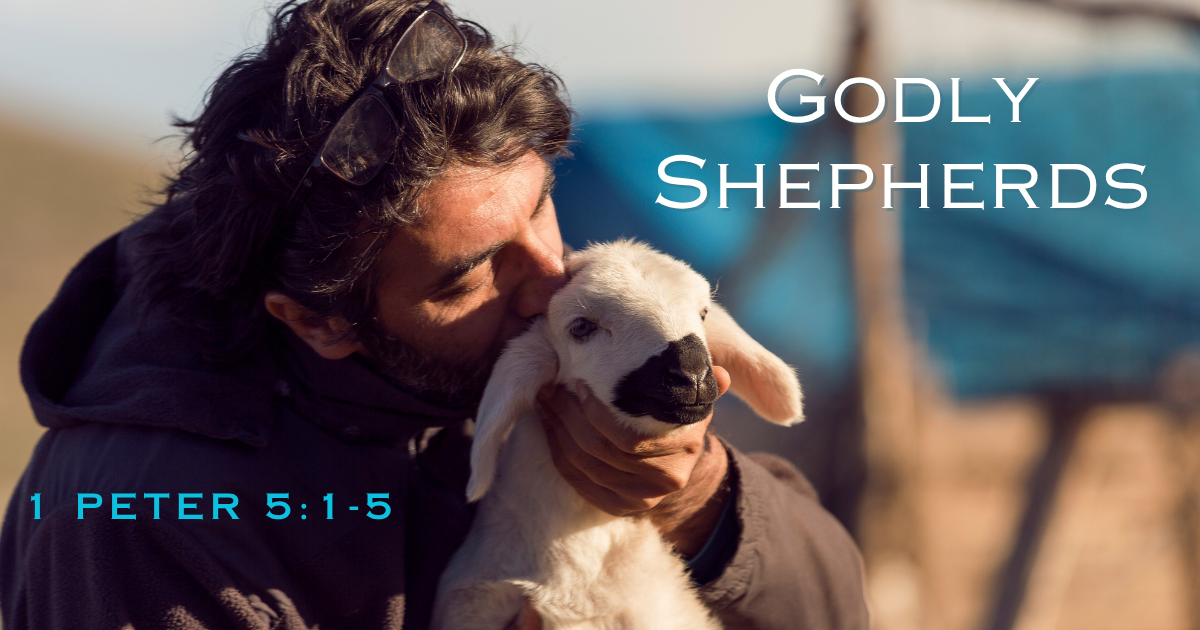
Scripture Reference: 1 Peter 5:1-5
Visit the series page: Exiles: A study in 1 Peter
-
Sermon Series: Spiritual Exiles
Message: The Sheep and Their Shepherds
Airdate: 11/5/2026
Programs: 2394
The Sheep and Their Shepherds
Today we are continuing an exposition in 1 Peter 5, verses 1 through 5. I’d like to begin by reading the text first. So I’m going to do that. Beginning in verse 1. Here’s what the Apostle Peter wrote. “So I exhort the elders among you as a fellow elder and a witness of the sufferings of Christ, as well as a partaker in the glory that is going to be revealed. Shepherd the flock of God that is among you, exercising oversight, not under compulsion, but willingly, as God would have you, not for shameful gain, but eagerly, not domineering over those in your charge, but being examples to the flock. And when the Chief Shepherd appears, you will receive the unfading crown of glory. Likewise, you who are younger, be subject to the elders. Clothe yourselves, all of you, with humility toward one another, for God opposes the proud, but gives grace to the humble.”
We’ve been studying this year this church in Asia Minor that Peter wrote to, and we discovered that they are displaced. They are in a community not their own, but it’s a spiritual picture of how exiled they are spiritually. Their faith that they have, what they believe about Christianity, is not at all embraced by the community and society around them. They’re suffering persecution as a result of that. Peter writes this letter to them to encourage them. And what we’ve seen so far is he rolls out several encouragements to them, included in this, would be the truth of the Gospel, the example of Jesus, his own example in his own life, future judgment, eternal rewards, and other things. All of them are wonderful. Every one of those applying to us as well ought to encourage us, help us persevere in the faith, help us stand up under trial and suffering.
But to ask the question, are those all that a Christian needs? Or maybe to say, is all a Christian needs is his Bible and a cup of coffee? Like, is that it? Is that enough? And then you come to chapter 5. I mean, you could have ended in chapter 4, but you get to chapter 5. And the Holy Spirit inspires Peter to write about spiritual leadership. To write about elders. To write about pastors. And we discover that every Christian needs a soul shepherd over them. That’s why he talks about it here.
Now this... doesn’t play well today because we live in an individualistic society where I want to think, “Hey man, I’m like my own man. I don’t need anybody else. It’s me and Jesus. I got my Bible. I’m good. I don’t need somebody else telling me what to do, leading, shepherding my soul. I don’t need that.” And yet, what do we know about what the Bible calls us? Sheep. Do you ever see sheep by themselves? Like if you’re driving down the road, you ever look over there in the meadow and it’s one sheep by himself? No, the only sheep you see by yourself along the road is the dead one, right? The roadkill. Sheep always flock together. And in the Middle East culture that this was written, you would always see sheep flocking together, and there would always be a shepherd with those sheep. And the Bible over and over again draws on this metaphor, this picture, and applies it to our own spiritual lives. In fact, we’re called sheep. All of us are sheep. It’s not a high compliment if you know much about sheep, but that’s what the Bible calls us to. God has made us to be spiritually sheep.
Now, one of the things about this is we have to embrace that. There’s a lot of movies and stories where, you know, there’s somebody, they’re this, but they want to be that, right? Kid stories a lot. So what do they have to do? They have to discover who they really are. They let it go. And then in the end, they discover who they are, and they find out they’re happiest being who they are. Kids love stories like that. It’s true for sheep as well. We could sort of look in the mirror spiritually and see ourselves as the lion roaming the Serengeti all by ourselves, so strong, so self-determined. But in reality, we’re just all sheep, aren’t we? We’re all sheep. God has made us this way. We get to do life around other sheep, which is sometimes wonderful, sometimes annoying. But that’s what we’re called to do.
And God has ordained that there are over the sheep what He describes, elders, overseers, pastor shepherds. They’re all describing the similar role within the church. And all of us, for our own spiritual good, we all need soul shepherding. None of us is sufficient on our own with our Bibles to become what God wants us to be as Christians. So for any flock then, any local church, it’s critical that the shepherds know what they’re supposed to be doing and the sheep know what they’re supposed to be doing. So I’m going to talk today with you about what good shepherding looks like and what good sheeping looks like. Important that the shepherd realizes what he’s doing and... that the sheep realize what he’s doing and what they’re supposed to be doing. And so this message is kind of an application message from last week’s exposition of these verses.
I want to start with the shepherd. What is good shepherding look like? And that phrase there, I’m actually taking from Jesus’ own self-description, where He called Himself the Good Shepherd. Although Peter doesn’t call Him the Good Shepherd, what does Peter call Him? He’s the what? He’s the Chief Shepherd, right? We better get that firm in our mind. Who is the actual shepherd of the church? It is Christ Himself. He is Lord over the church. He is the shepherd of the souls of the church. He’s the shepherd of the sheep of the church. And in the church, Jesus has deputized, granted authority to under shepherds who express His intended leadership over the local church. This is who Peter is writing to. These are the elders of the church.
Now, Jesus’ shepherding is, of course, perfect. Everything that our souls need, we find in Him. Every quality that would make for a good shepherd, He is perfect. He is the epitome of what soul shepherding needs to look like. So under shepherds, then, the deputy shepherds can look to Jesus in terms of an example, as far as like, what am I supposed to be doing? And sheep can look to Jesus and say, this is what the effect or the fruit of good shepherding ought to be in my life. And here is where I think Psalm 23 provides such a wonderful picture of good shepherding.
We typically look at Psalm 23 in a moment of trial, troubles, you know, we’ve lost a loved one. It’s wonderful for that, for sure. Very devotional, very rich. But what about looking at it from the perspective of what good leadership in the church ought to do and produce within the flock? So let me read it now from that perspective. Listen. “The Lord is my shepherd, I shall not want. He makes me lie down in green pastures. He leads me beside still waters. He restores my soul. He leads me in paths of righteousness for His name’s sake. Even though I walk through the valley of the shadow of death, I will fear no evil, for You are with me. Your rod and Your staff, they comfort me. You prepare a table before me in the presence of my enemies. You anoint my head with oil, my cup overflows. Surely goodness and mercy shall follow me all the days of my life, and I will dwell in the house of the Lord forever.”
Poetically beautiful, faithful language, don’t you think? There’s a reason we turn to it in times of trouble. But here we have a picture of the Lord shepherding us. The Lord is my shepherd. We all should be able, Christians, we all should say that in terms of, like, my actual shepherd. It’s not the elder in the church. It’s not the pastor in the church. The actual shepherd is the Lord Jesus Christ. He is the Chief Shepherd. And what does He do? We see Him here. He provides for my needs. The Lord provides rest for His sheep. The Lord provides sustenance. He directs me towards righteous living. He calms our fears. His rod disciplines and His staff guides. He is a friend when enemies surround us. And the effect of His shepherding in our life is the overflowing resourcing of our faith no matter what comes, right? Our cup overflows. So we look at that and we say, there’s really, really good shepherding. And shepherds in the church, we need to look at that and go, that’s what I ought to be striving for in the faith walk of the sheep that are in my flock.
So to summarize, what does a shepherd do? Two things. First of all, the shepherd leads the sheep. The shepherd leads the sheep. We see that here in chapter 5, verse 2. “Shepherd the flock of God that is among you. Exercising oversight.” That’s what Peter says here. And it’s the grammar there. It’s an imperative. He’s shouting as he says that. “Elders, lead the church. Exercise authority. Care for the church. Don’t be irresponsible. Don’t be negligent. Don’t be lazy. Be about it. Be on it.”
Here’s some other admonitions from Scripture regarding elders leading the church. Acts 20, verse 28, Paul meets with the Ephesian elders, and he says, “Pay careful attention to yourselves and to all the flock in which the Holy Spirit has made you overseers to care for the church of God, which He obtained with His own blood.” Titus 1:9, he, regarding the elder in the church, “must hold firm to the trustworthy word as taught so that he may be able to give instruction in sound doctrine and also to rebuke those who contradict it.” Here’s 1 Timothy 5:17, “Let the elders who rule well.” And Titus 1:7, “He is God’s steward.” The elder is the steward over the flock. He is overseeing the flock.
But what kind of oversight is he to have? Well, what does the Chief Shepherd do? How did the Chief Shepherd exercise authority in the church? Was He kingly? Was He a dictator? Was He autocratic? Was He dictatorial in the manner in which He shepherded the flock? And of course, we look at the life and the ministry of Jesus, and we see the opposite of that, don’t we? He did not come to be served, but to... serve, and to give His life as a ransom for many. The example, the ultimate shepherd, is one who came and gives His life for the sheep. And we see in that the kind of leadership within the local church that leaders are called to. It is not a rising to power, it is a rising to service. It is a taking up the basin and the towel, washing the feet as Jesus did in the upper room, to care for the needs, to serve and to minister to the sheep in the flock. Or to say it this way, spiritual leadership is servant leadership. It is servant leadership.
This is true wherever God gives authority, by the way. What is the government called to do? An easier example, what is the husband called to do in that marital relationship? Ephesians 5, he is to love his wife as Christ loved the church and gave Himself up for her. Husbands, we are called not to rule and to reign, but to lead by serving our wife for her good, for her benefit. Or to think of a father in a home. What is he called to do? Is he the king of the castle? Like, does he have his throne there and all the serfs sort of, you know, run around at his feet? Just during football. That’s the exception. “I need a drink.” No. In marriage and in the home, to lead is to serve. To lead is to serve. And that’s why Paul says for qualifications, make sure that he manages his own household well. Because if he can’t spiritually shepherd that little context of the home, how can he possibly do it in the church of God? So do it well in the home, be a servant leader in the home, and then perhaps God will expand your responsibilities.
So it’s not about authority or power or position. It is not to be heavy-handed or dictatorial. It’s never to be selfishly ambitious. Elders are to serve for the good of the flock and to lead like Jesus led. And sheep need to sort of want that, to want that. And this is why the emphasis when it comes to leadership in the church is in the New Testament, the qualifications focus on the character of the leader. I’m always surprised by that. You read through the qualifications, and we typically, don’t we, we sort of look to the person who’s got the amazing oratorical skill or they’ve got this great organizational skill or they’re an amazing leader in business or something like that. And we think, “Ah, there we have a leader.” And then you read the New Testament. And the focus is on the integrity of the life of the leader, his character, his heart.
In fact, let me read. This is 1 Timothy 3. The Apostle Paul giving the qualifications for an elder in the church. Listen to what his focus is. “If anyone aspires to the office of overseer, he desires a noble task. Therefore, an overseer must be above reproach, the husband of one wife, sober-minded, self-controlled, respectable, hospitable, able to teach, not a drunkard,” you’ve got a list of nots now, “not a drunkard, not violent but gentle, not quarrelsome, not a lover of money. He must manage his own household well with all dignity, keeping his children submissive. For if someone does not know how to manage his own household, how will he care for God’s church? He must not be a recent convert, or he may become puffed up with conceit and fall into the condemnation of the devil. Moreover, he must be well thought of by outsiders so that he may not fall into disgrace, into a snare of the devil.”
And I don’t have time to take that apart. We’ve done so in the past. What I want you to see in this, again, is the focus of attention. It is on the character, the integrity, the life of the leader. Now, we all affirm that. We all think that’s great. But why is that the focus? Why not the best speaker? Why not the best looking? Why not the most educated or some other category? And I think the reason is because of what Peter says in verse 3. Elders are to be examples to the flock.
Here’s something that the Holy Spirit knows about sheep. We may be drawn to the sort of charismatic individual or the oratorical or the educated or whatever. We may be drawn to that, but we can’t relate to the guy who’s read every commentary on the shelves, and we can’t quite get the guy who’s gifted, you know, sort of out there, amazing, gifted. But sheep can follow an example. God has wired us that way. We can follow an example of somebody who lives out Christianity in a way that we can aspire to. And that has way more to do with character than gifting. The character of the leader. God wants elders who are examples of the gospel and examples of grace and examples of holiness of life, at least pursuant to that. Sheep can look over many quirks of style. And I want to thank you right now for doing so. We can overlook many things when we look up to the moral and spiritual example of those that God has put over us. And so elders are called to lead by serving. They are called to lead by example.
Second thing shepherds are called to do is to love the sheep. Love the sheep. Let me read to you that Good Shepherd passage I referred to earlier. Listen to Jesus’ description of Himself in shepherding terms, the way that He feels, looks at, relates to the sheep. He says in John chapter 10, “I am the Good Shepherd. The Good Shepherd lays down his life for the sheep. He who is a hired hand and not a shepherd, who does not own the sheep, sees a wolf coming and leaves the sheep and flees. And the wolf snatches them and scatters them. He flees because he is a hired hand and cares nothing for the sheep. I am the Good Shepherd. I know my own and my own know me. Just as the Father knows me and I know the Father. And I lay down my life for the sheep. And I have other sheep that are not of this fold. I must bring them also, and they will listen to my voice. So there will be one flock, one shepherd.” Isn’t that beautiful?
And obviously Jesus here is describing this relationship in terms of His mission. I came, I came to give my life for the sheep. And there might be occasion in church history where a pastor is called actually to do that. But in this way, Jesus’ role was unique, wasn’t it? He came to die for the sheep. But those that are shepherds in the church are called similarly to love the sheep.
Now, the way that this works, by the way, is not because the sheep are so inherently wonderful and endearing. Sometimes, but not all the time, right? So the shepherd who is shepherding simply because he thinks the sheep are wonderful are not going to last very long, because sheep become unwonderful at times, kind of like loving your kids. They’re mostly wonderful most of the time, sometimes a challenge. Why does the shepherd, the under shepherd, love the sheep? Think back to what Jesus said. This is after the resurrection. He’s restoring Peter. He says to Peter, “Do you love me?” Peter says, “You know that I love You.” What does Jesus repeat three times? “Feed my sheep.” The basis of the shepherd loving the sheep is not the wonderfulness of the sheep, but the fact that Jesus loves the sheep.
And when you love somebody, you love what they love. And so the under-shepherd, realizing that the sheep have their certain qualities and quirks and all of that that make things difficult, and there are trials that come to a congregation that make things difficult, the reason the shepherd hangs in there is because he knows that Christ loves the sheep, and we love for His sake. I would say that to seminarians who are studying for ministry. I would say. It is your relationship with Jesus that will allow you to persevere in ministry. It will not be your relationship with the sheep. Do you love Christ? Maintain that, and you’re going to have a place where you can love the sheep in their ups and downs and in the ups and downs of the story of the church.
When I recognize that each and every one of you are an object of the eternal love of God, that eternity past, God, chose to love you, purposed the plan of redemption, that Jesus, obedient to that will, incarnated Himself, went through all of the weakness and the suffering of being a human being on this earth, all the things that He went through in His Passion Week, indeed His death on the cross, all of the seven sayings, “Father, forgive them, they know not what they do,” and all that He endured in that moment, three days dead in the grave. To realize that Jesus did this for you causes the shepherd to view the sheep through that lens and to love them in spite of their weakness and in spite of their non-sanctification and in spite of their sin or whatever it might be, to enduringly love the sheep.
What is greatness in the kingdom of God? To be the... servant of all. And for the higher the responsibility in the church, for the more the sense of taking up the basin and the towel and being willing to humble ourselves and to serve the sheep is what keeps it from becoming political. And all the sort of, like, positioning thing that sometimes can happen in local churches. That is not God’s plan. That is not the church. And it certainly isn’t the example of Jesus. He takes leadership and He puts it upside down. It is servant leadership.